
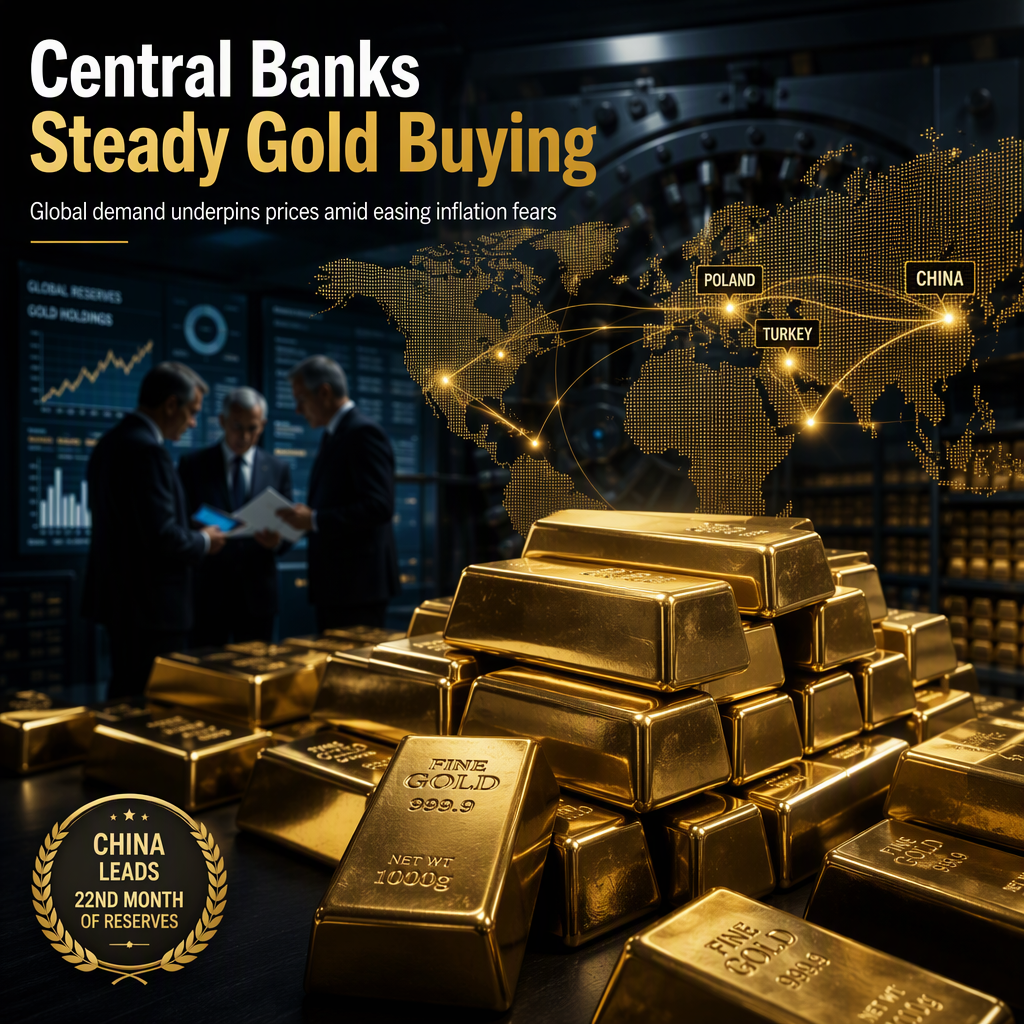
Gold prices edged higher on Tuesday, recovering from early losses as lower oil prices and stronger bond markets helped ease inflation concerns and reduced expectations for further interest rate hikes, according to ING’s commodities team led by Warren Patterson and Ewa Manthey [1]. Persistent central bank demand continues to underpin gold prices, with World Gold Council data showing central banks remained net buyers in August, adding 39 tonnes and bringing year-to-date purchases to 170 tonnes [1].
China led the purchases with 20 tonnes in August, marking its 22nd consecutive month of gold buying. Poland and Uzbekistan each added 8 tonnes to their reserves, while Turkey returned as a net buyer after three months of net sales, purchasing 3 tonnes [1]. Other buyers included Kazakhstan, the Czech Republic, Bolivia, and Ghana. In contrast, Russia reduced its gold holdings by 6 tonnes [1].
The ING report highlights that official-sector demand remains resilient despite elevated gold prices, with purchases driven by long-term reserve diversification objectives rather than short-term market movements [1]. The ongoing accumulation by China, Poland, and several emerging-market central banks suggests that official-sector demand will likely continue to support the gold market in the coming months [1].
CONCLUSION
Central banks' sustained gold buying, led by China and supported by several emerging-market nations, continues to bolster gold prices despite elevated levels. With official-sector demand expected to remain robust, gold is likely to retain support from reserve diversification strategies in the near future.