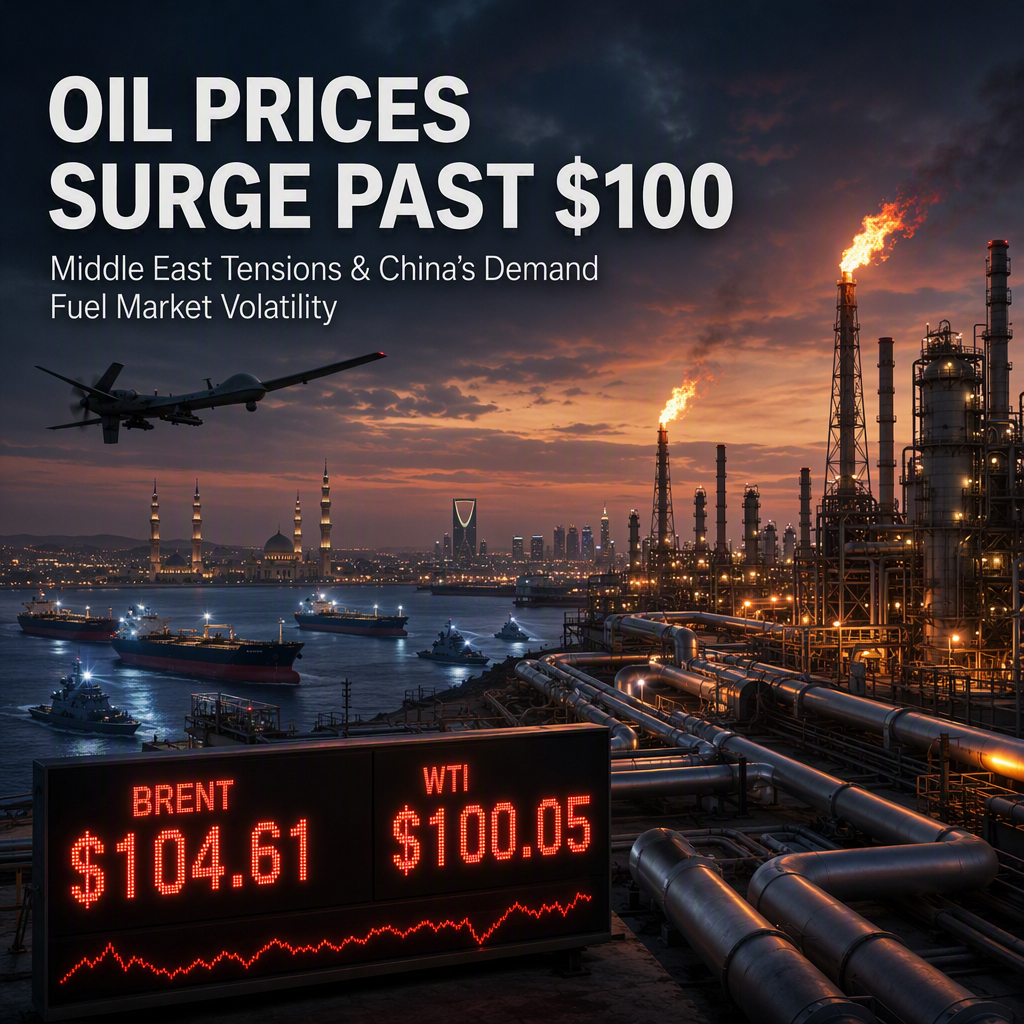
Oil prices surged above $100 per barrel this week for the first time since May, driven by escalating conflict in the Persian Gulf and renewed attacks on Saudi Arabia’s critical East-West crude oil pipeline [1][2]. Brent crude futures settled at $104.61 per barrel, down 2.8% on Friday, while U.S. West Texas Intermediate (WTI) closed at $100.05, down 2.4%. Earlier in the week, Brent peaked at around $108 and WTI at over $104 [1]. The pipeline, which has a capacity of 7 million barrels per day, was shut down after multiple drone attacks originating from Iraq caused fires and injuries in the Riyadh and Medina regions, according to the Saudi government [1][2]. President Donald Trump stated that Iran was likely responsible for the attacks, and that the ongoing war in Iran could end soon after the upcoming mid-term elections, predicting a sharp fall in oil prices once hostilities cease [1].
The oil market’s recent rally follows the collapse of a memorandum of understanding between Washington and Tehran in June and the subsequent reimposition of a U.S. naval blockade of Iran in July [2]. Despite the escalation, U.S. crude prices remain below their April 7 wartime closing high of $112.95 [2]. Analysts highlighted that China’s crude oil import behavior could be a decisive factor for future price movements. China, which has acted as a swing consumer during the Iran war, slashed its crude imports by 3 to 5 million barrels per day, relying on its petroleum reserve of over 1 billion barrels [2]. However, Chinese imports have rebounded from a wartime low of 6 million bpd in June to around 7 million bpd in July and August, with current buying activity holding steady [2].
Rebecca Babin, senior energy trader at CIBC Private Wealth, noted that the market may not have fully priced in the potential for increased Chinese demand, as refiners are incentivized by soaring diesel profit margins resulting from disrupted global refining capacity due to the Iran and Ukraine wars [2]. Amrita Sen of Energy Aspects stated that while China’s crude purchases are not expected to return to prewar levels, they have increased from spring lows [2].
Diplomatic efforts are underway, with Iranian and Gulf officials scheduled to meet in Oman to discuss the Strait of Hormuz and potentially sign an agreement establishing an Iran-Oman shipping route [1]. Despite these talks, Iranian President Masoud Pezeshkian asserted that Iran would not surrender to U.S. and Israeli pressure, emphasizing the country’s resistance to aggression [1].
Market participants are closely watching both geopolitical developments and China’s import activity for further direction. The combination of supply disruptions, diplomatic uncertainty, and shifting demand dynamics continues to inject volatility into the oil market [1][2].
CONCLUSION
Oil prices have surged past $100 per barrel amid heightened Middle East tensions and supply disruptions, with the market’s next move hinging on China’s crude import decisions. Diplomatic efforts and statements from key leaders suggest ongoing uncertainty, keeping volatility elevated. The market remains highly sensitive to both geopolitical developments and shifts in global demand.