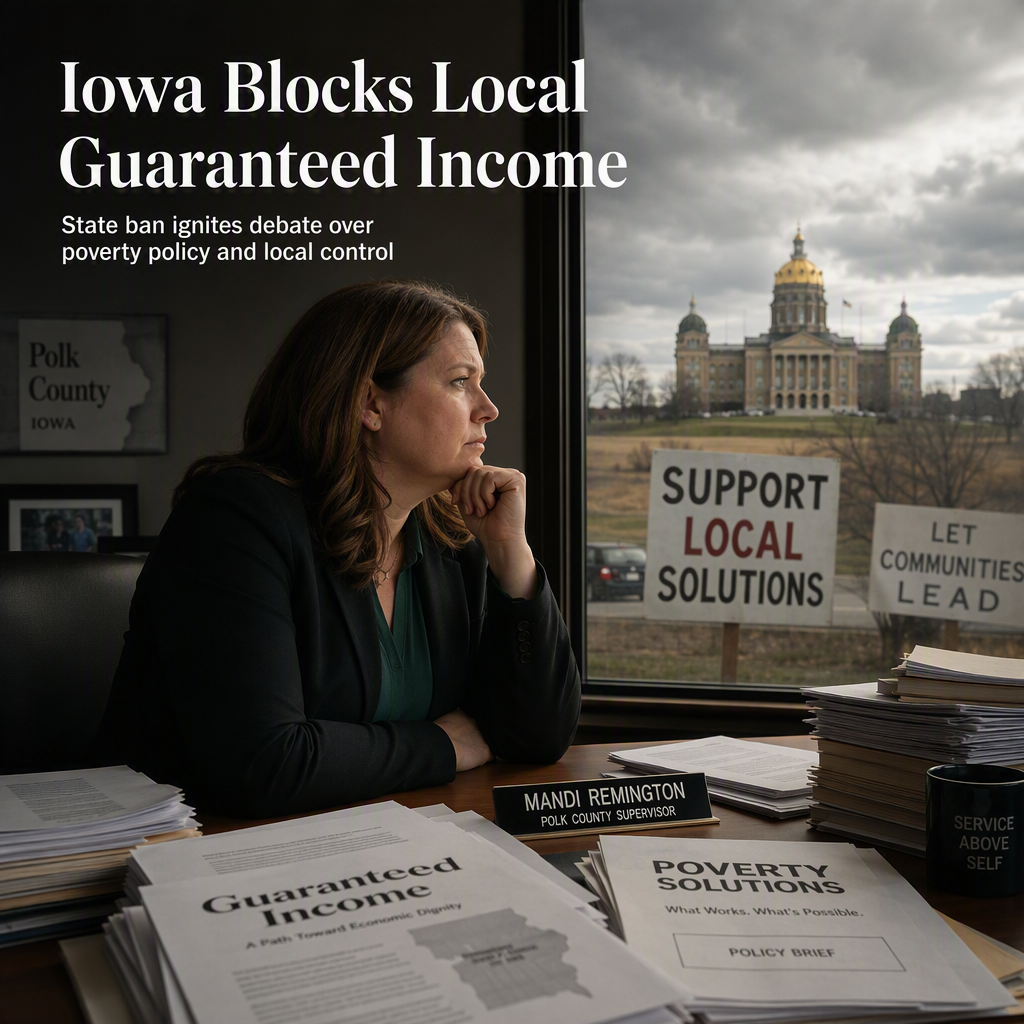
Iowa state lawmakers have enacted a ban on guaranteed income programs at the local level, preventing cities and counties from testing direct cash payments to residents as a poverty-alleviation measure [1]. The legislation, House File 2319, was signed into law by Republican Governor Kim Reynolds on May 1, 2024 [1]. The move has drawn criticism from local officials, including Mandi Remington, a Democratic county supervisor in Johnson County, who argued that the ban restricts local governments' ability to address poverty and conduct policy research [1].
Remington highlighted that the Johnson County Board of Supervisors, with support from Supervisor V Fixmer-Oraiz, had attempted to launch a guaranteed income initiative inspired by similar pilots such as the UpLift trial in central Iowa, which provided 110 families with $500 per month for two years [1]. She contended that the proposed policy would have built on successes observed in other jurisdictions [1]. However, the state-level ban halted these efforts before they could begin [1].
Proponents of the ban, including Republican lawmakers, argued that government cash handouts undermine the American work ethic, subsidize low wages, and foster government dependency [1]. Remington countered that the ban represents an ideological battle rather than evidence-based policymaking, stating that state leaders are more interested in controlling local government than in helping working families [1]. She also expressed frustration that legislators were not open to hearing evidence from other places or conducting research on the effectiveness of guaranteed income programs [1].
The ban has sparked a debate over local control and the role of state government in shaping social policy, with critics claiming it obstructs innovative approaches to addressing poverty [1].
CONCLUSION
Iowa's new law banning local guaranteed income programs has halted efforts by counties like Johnson to test direct cash payments as a poverty solution. The move has intensified debate over local versus state control, with critics arguing the ban prioritizes ideology over evidence-based policy. Market impact is expected to be low, as the legislation primarily affects local governance and social policy experimentation.