
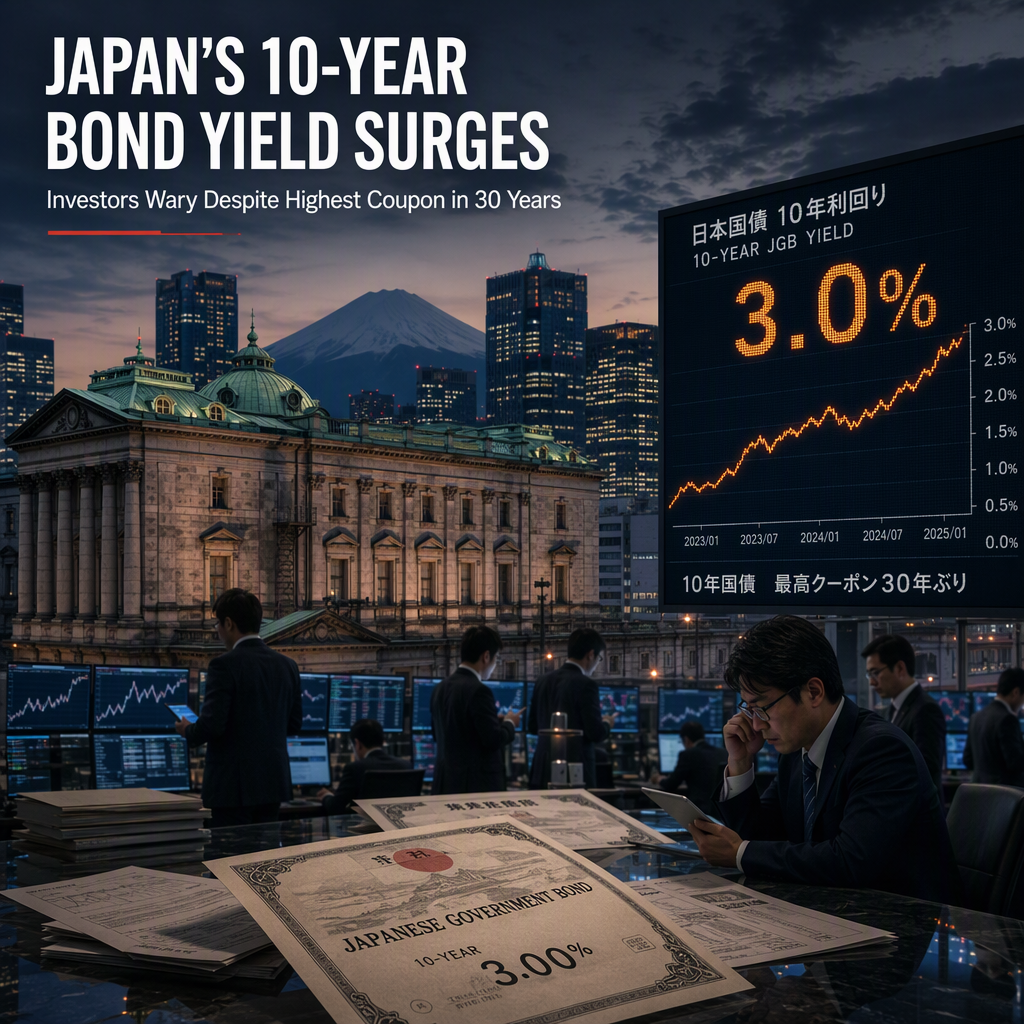
The benchmark Japanese government bond (JGB) yield increased on Tuesday, even as the coupon rate on new 10-year JGBs surpassed 3% for the first time in three decades [1]. This rise in yield occurred despite a smooth government bond auction, highlighting persistent investor concerns over Japan’s fiscal outlook and global inflationary pressures [1]. The elevated coupon rate, which would typically attract buyers, was insufficient to offset market skepticism regarding Japan’s fiscal sustainability and the broader trend of rising yields driven by government debt fears worldwide [1].
Investors remain uneasy due to ongoing inflation concerns, which are exacerbated by the protracted conflict in the Middle East and worries about Japan’s fiscal trajectory [1]. Financial analysts noted that the attractive coupon failed to generate enough demand to counterbalance apprehensions about future fiscal burdens and inflationary risks [1]. A Tokyo-based bond strategist commented, “The auction was smooth, but investors are clearly pricing in future risks. We could see further upward pressure on yields if fiscal concerns deepen or if inflation expectations rise” [1].
Technical analysis suggests that the 10-year JGB yield could test new highs if the global bond sell-off intensifies, with market participants closely monitoring support and resistance levels, particularly those not seen since the mid-1990s [1]. Volatility is expected to persist as global bond markets remain under pressure, and traders are watching for further developments in inflation and fiscal policy [1].
CONCLUSION
Japan’s 10-year government bond yield rose despite a historically high coupon, reflecting deep-seated market concerns over fiscal sustainability and inflation. The market reaction underscores ongoing volatility and the potential for further yield increases if fiscal or inflationary pressures intensify. Investors are expected to remain cautious as global debt fears continue to influence bond markets.