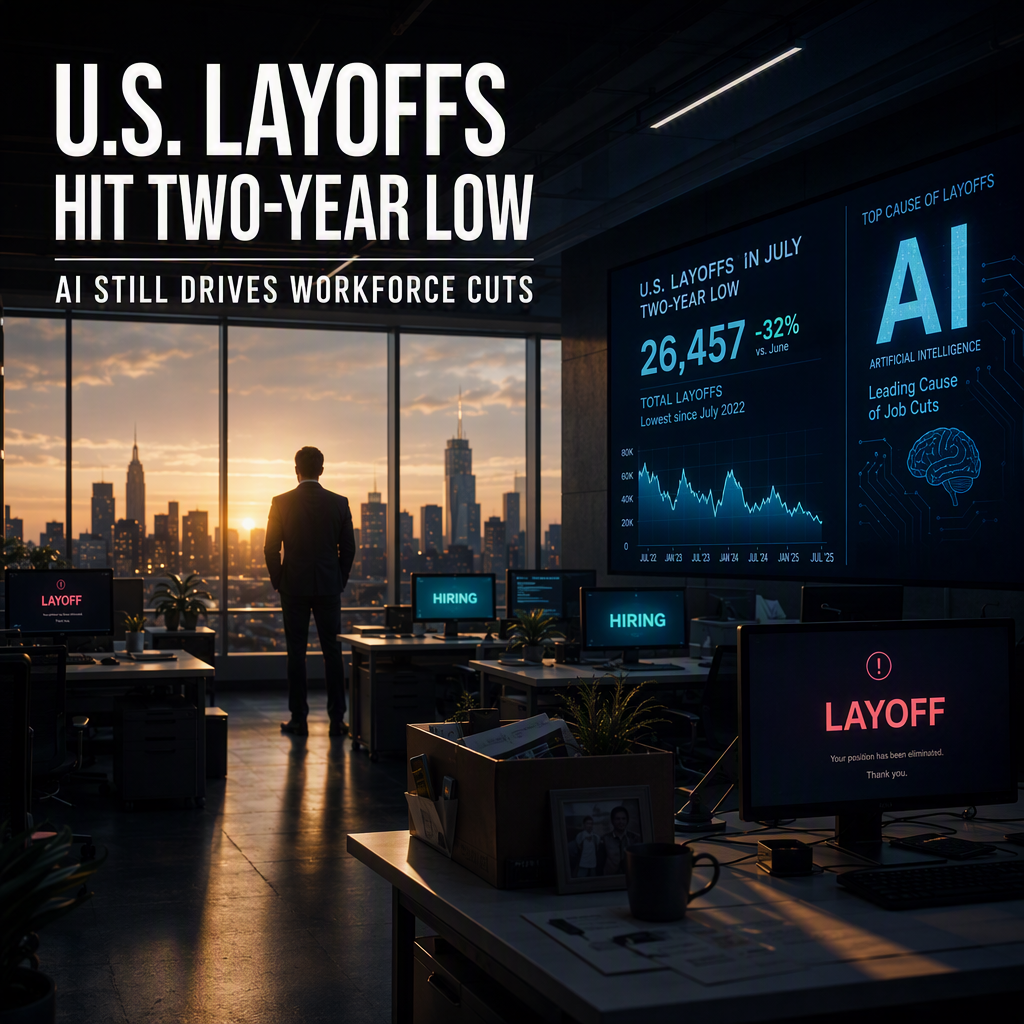
According to data from Challenger, Gray & Christmas, U.S. companies announced 33,429 job cuts in July, marking a 27% decrease from June's 45,849 and a 46% drop from the 62,075 layoffs announced in July of the previous year [1]. This figure represents the lowest monthly total in two years, with the last comparable low being 25,885 cuts in July 2024 [1]. The report highlights that this is the fifth time in 2026 that monthly job cuts have been lower than the corresponding month a year earlier [1].
Year-to-date, employers have announced 477,033 job cuts through July, a 41% decline from the 806,383 cuts reported in the first seven months of 2025 [1]. The tech sector remains the most affected, with 9,867 job cuts in July and a year-to-date total of 149,023, which is a 67% increase from the same period last year [1]. Tech layoffs account for 31% of all job cuts announced this year, with artificial intelligence (AI) cited as the primary reason for these reductions [1]. Financial firms and government agencies followed, with 3,157 and 2,962 cuts in July, respectively. Notably, government sector layoffs are down 93% from last year, largely due to fewer federal workforce reductions [1].
AI was the dominant reason for workforce reductions across industries, responsible for 10,970 cuts in July, or 33% of the total [1]. This marks the fifth consecutive month that AI has been the top reason cited for layoffs. So far in 2026, AI has been cited in 112,713 job cut announcements, accounting for about 24% of all cuts, and since tracking began, AI has been the reason for 184,538 job cuts [1]. The report notes some ambiguity in what constitutes an AI-related cut, as some employers cite AI explicitly while others reference technology deployments more generally [1].
Despite the impact of AI on layoffs, hiring has increased by 25% over last year, indicating that while AI is reshaping the labor market, it is not dismantling it, according to Andy Challenger, chief revenue officer for Challenger, Gray & Christmas [1].
CONCLUSION
Layoffs in the U.S. dropped to their lowest level in two years in July, with AI continuing to drive workforce reductions, especially in the tech sector. Despite these cuts, overall hiring has increased, suggesting that the labor market remains resilient amid ongoing technological transformation.