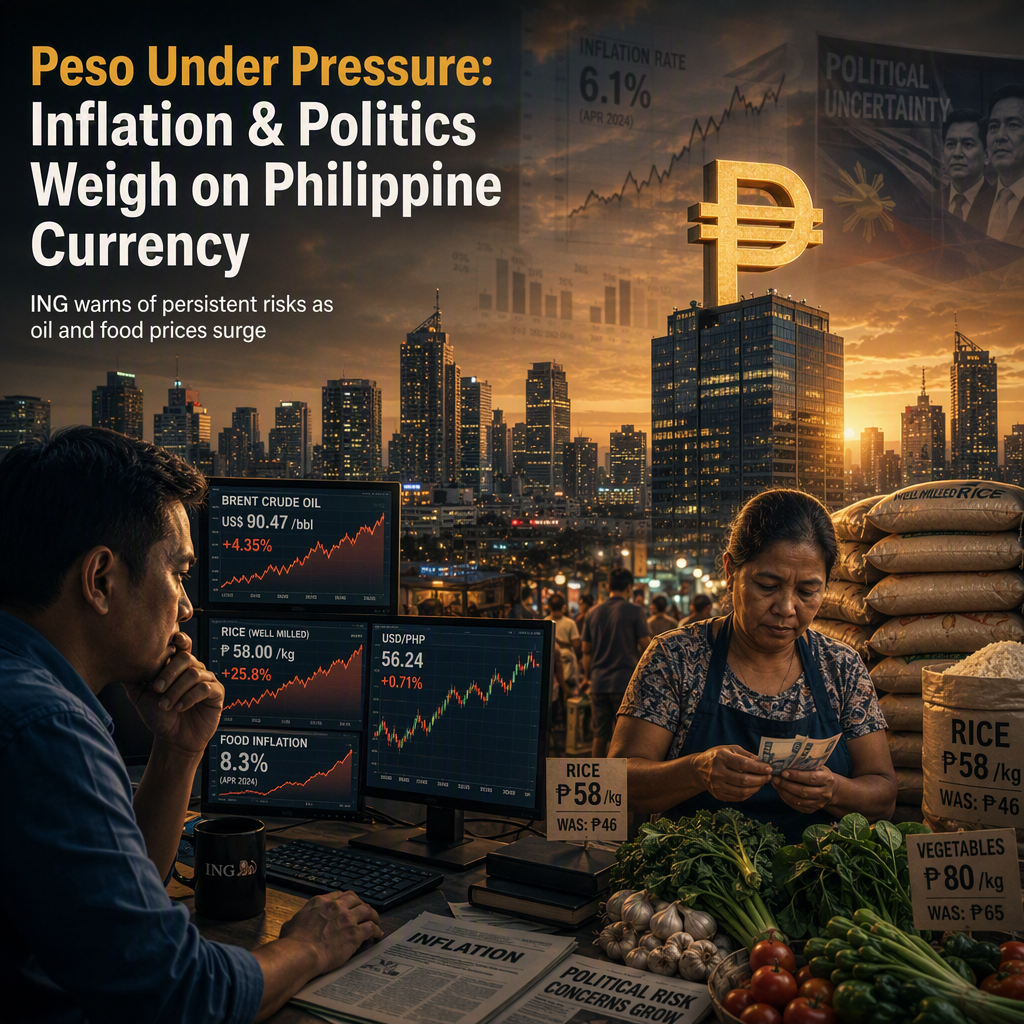
ING economists Deepali Bhargava and Lynn Song have highlighted that the Philippine Peso (PHP) is coming under renewed pressure due to increasing inflation risks. These risks are attributed to a recovery in oil prices and expectations of a strong El Niño later in the year, which could trigger a food inflation shock in import-dependent economies such as the Philippines [1]. The economists note that global rice prices are rising as countries seek to secure supplies, and fertiliser prices are also expected to rebound from recent lows, driven by renewed US-Iran tensions and supply disruptions [1].
Persistent inflationary pressures are likely to prompt a continued hawkish policy stance from the central bank, with ING forecasting an additional 50 basis points of tightening in 2026 [1]. However, the analysts caution that political uncertainty remains a significant downside risk. Such uncertainty could delay necessary reforms, dampen economic growth, and maintain downward pressure on the peso [1].
No specific market reactions or analyst opinions beyond ING's outlook are mentioned in the article. The focus remains on the interplay between inflationary forces and political risks, and their potential to influence monetary policy and the peso's trajectory [1].
CONCLUSION
The Philippine Peso is facing renewed downside risks due to rising inflation pressures and political uncertainty, according to ING economists. Persistent inflation may lead to further monetary tightening, but political factors could hinder reforms and growth, sustaining pressure on the currency.