
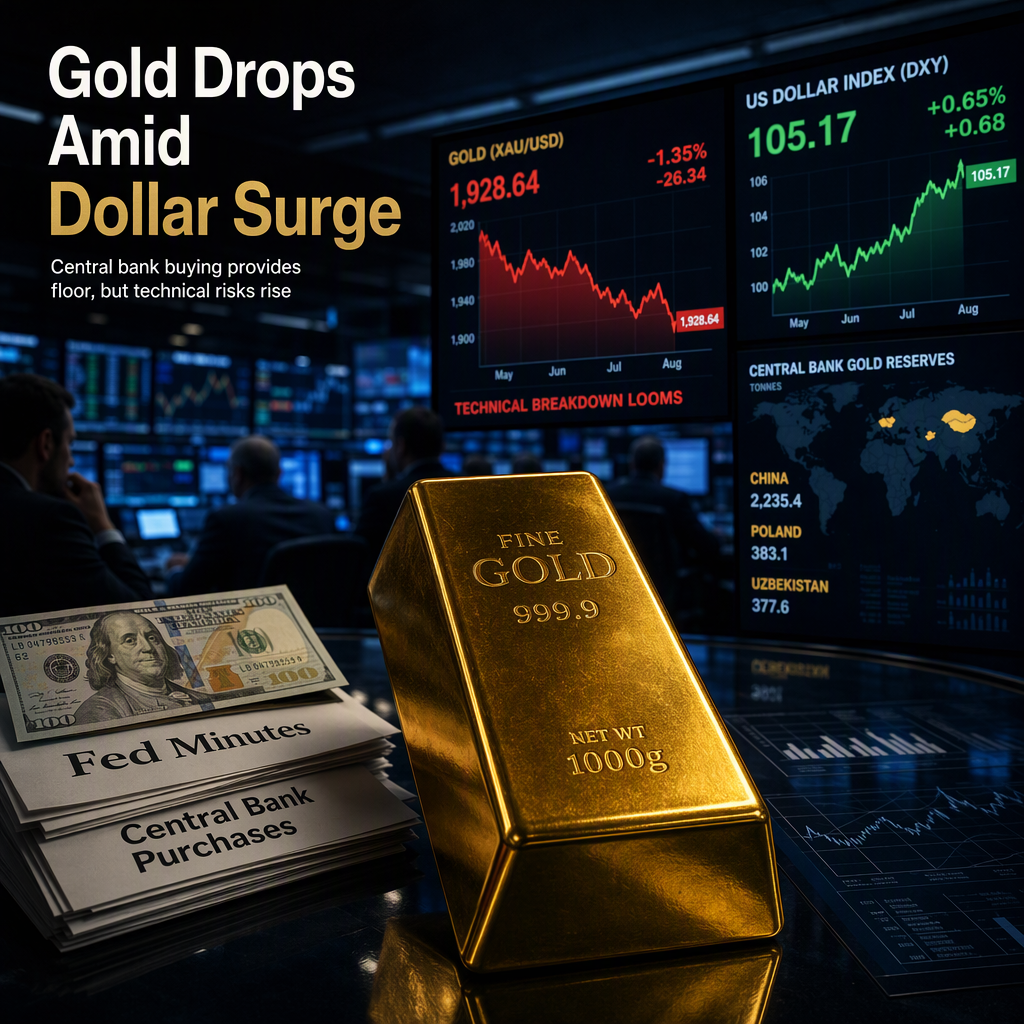
Gold (XAU/USD) declined by nearly 1.20% on Wednesday, trading around $4,114, as the US Dollar and US Treasury yields rebounded ahead of the release of the Federal Reserve's September meeting minutes at 18:00 GMT [1]. The US Dollar Index (DXY) hovered near 102.30, close to levels last seen in April 2025, while the benchmark 10-year US Treasury yield rose to approximately 5.324%, nearing its 2002 high of 5.349% [1]. The rise in yields and the US Dollar has increased the opportunity cost of holding non-yielding assets like gold, making it more expensive for buyers using other currencies [1].
The market is closely watching the Federal Reserve's policy direction. After a 25-basis-point rate hike in September—the first in three years—Fed Chair Kevin Warsh delivered a hawkish message, prompting investors to anticipate back-to-back rate hikes [2]. However, softer-than-expected US employment and PCE inflation data last week have tempered those expectations, with markets now widely expecting the Fed to keep rates unchanged at its October 27-28 meeting, though the possibility of another hike in December remains due to persistent inflation risks, particularly from elevated energy prices [1][2].
On the technical front, gold's failure to hold above its 200-day Simple Moving Average (SMA) at $4,510/$4,540 has exposed key supports, with Societe Generale strategists warning that a drop below $4,095 could deepen the downtrend toward $4,000 and the June/July troughs at $3,960/$3,940 [3]. This technical weakness contrasts with strong official-sector demand: World Gold Council data shows central banks were net buyers in August, adding 39 tonnes and bringing year-to-date purchases to 170 tonnes [1][3]. China led with 20 tonnes, marking its 22nd consecutive month of buying, while Poland and Uzbekistan each added 8 tonnes [1][3]. ING analysts emphasize that this demand is driven by long-term reserve diversification rather than short-term market moves, and they expect official-sector buying to remain a key source of support in the coming months [1][3].
Despite the robust central bank demand, gold remains more than 25% below its January all-time high near $5,600, weighed down by a hawkish Fed outlook and ongoing geopolitical and inflationary pressures [1]. ING and Societe Generale agree that central bank buying is providing a floor for gold prices, but Societe Generale cautions that technical breakdowns could still drive prices lower in the near term [3].
CONCLUSION
Gold is under pressure from a strengthening US Dollar and rising Treasury yields, with technical signals pointing to further downside risk if key support levels fail. However, persistent central bank buying, led by China, continues to provide a structural floor for the market. Traders are awaiting the Fed minutes for further policy clues, with the balance between technical weakness and official-sector demand likely to shape gold's near-term trajectory.