
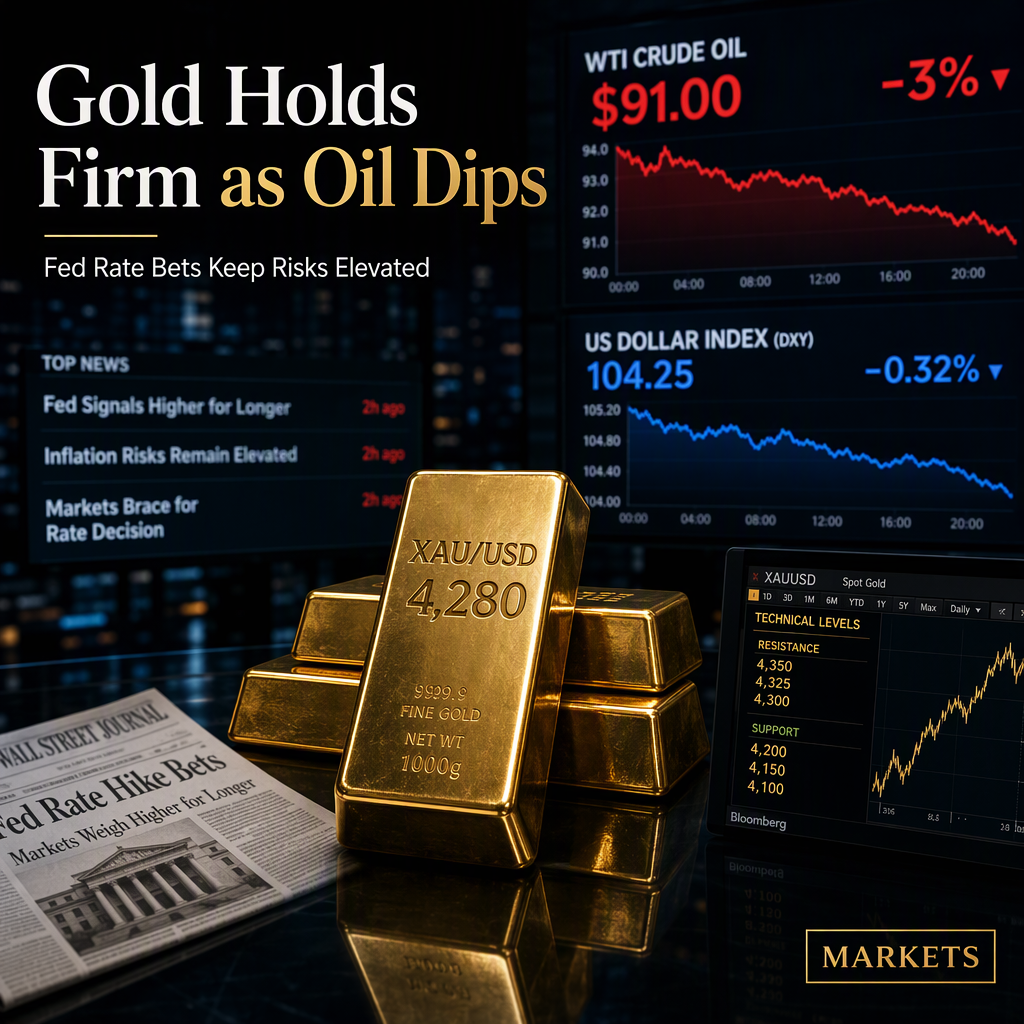
Gold (XAU/USD) prices held firm on Friday after two consecutive days of losses, trading at $4,280 after reaching a low of $4,254. This stabilization occurred as US bond yields remained elevated and inflationary concerns persisted, increasing the likelihood of further monetary tightening by the Federal Reserve and other major central banks [1]. The yellow metal recovered some ground as oil prices, specifically West Texas Intermediate (WTI), dropped over 3% to $91.00 per barrel, influenced by progress in US-Iran negotiations, although a senior Iranian official stated that the Strait of Hormuz would remain closed and conditions for nuclear talks had not been met [1].
The US Dollar Index (DXY) declined by 0.22% to 101.02, while the US 10-year Treasury yield edged down nearly 2 basis points to 5.192%, even as traders increased bets on continued Fed tightening. Economic data showed core Durable Goods Orders in the US rose above estimates in August, with July data also revised upward, indicating robust business spending. However, the University of Michigan Consumer Sentiment Index for September fell to a four-month low of 48.1, down from 51.7 in August, as rising inflation concerns eroded household purchasing power. Americans revised their one-year inflation expectations upward to 4.6% from 4%, and five to ten-year expectations to 3.4% from 3.3% [1].
Fedspeak during the week contributed to a leg lower for gold and increased the probability of a rate hike at the October meeting to 64%, with nearly 93% odds for a hike by December, according to Prime Terminal [1]. Technical analysis indicates that gold's bias remains tilted to the downside, with the price subdued within a 'bullish wedge' pattern and resistance at the 100- and 50-day SMAs ($4,304-$4,312) capping recovery above $4,300. The Relative Strength Index (RSI) remains below the neutral 50 mark, suggesting continued bearish momentum. A break below the $4,200-$4,210 level would invalidate the bullish wedge and open the path to test the August 3 low of $4,019, with $4,000 as the next target. On the upside, resistance levels are at $4,300, $4,350, and $4,400 [1].
CONCLUSION
Gold prices stabilized amid a slump in oil prices and a softer US Dollar, but persistent inflation concerns and expectations of further Fed tightening kept the outlook bearish. Technical indicators suggest downside risks remain, with key support and resistance levels in focus. Market participants are closely watching upcoming Fed decisions, which are likely to drive gold's next move.