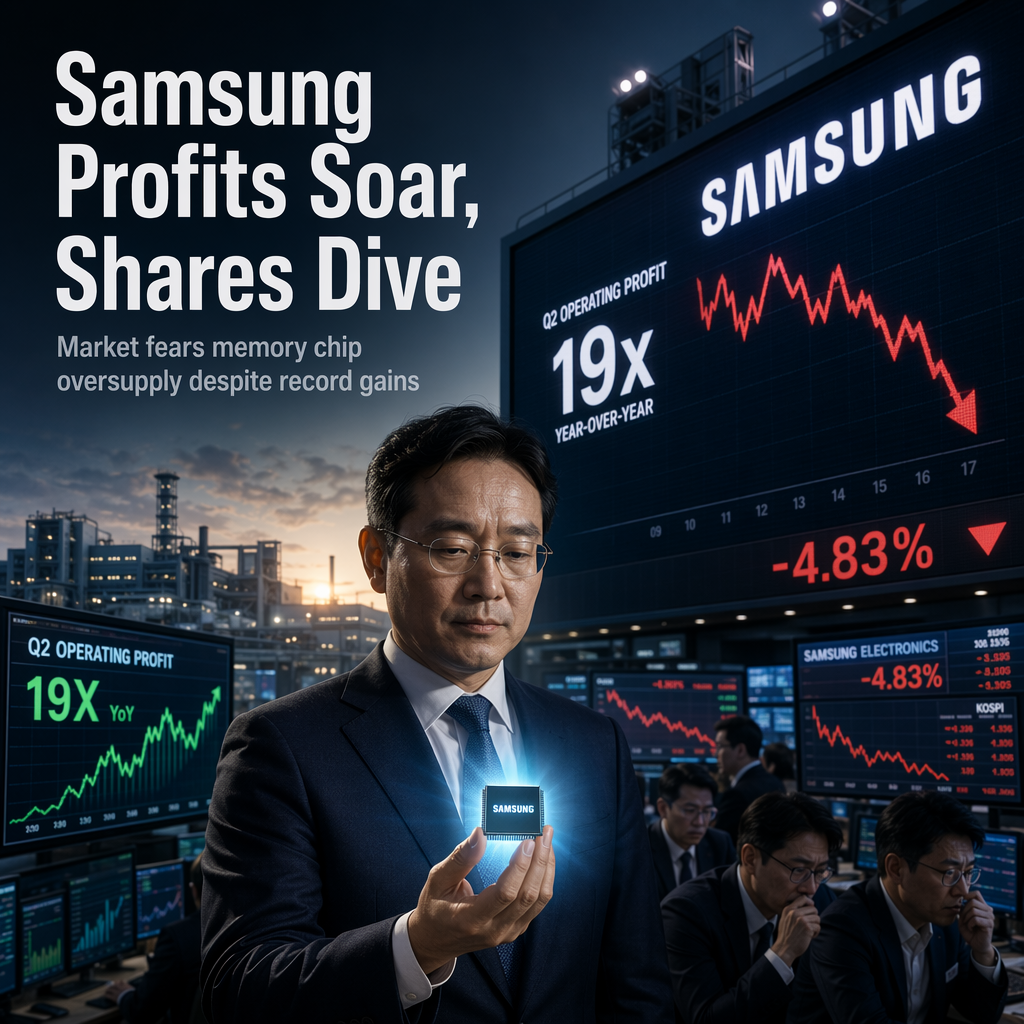
Samsung Electronics reported a dramatic increase in operating profit for the second quarter, soaring more than 19 times year-on-year to 89.4 trillion won ($58.4 billion), driven by continued tightness in the memory chip market and rising demand for artificial intelligence computing [1]. Despite this substantial profit growth, Samsung's shares fell sharply by 6.9% following the announcement, reflecting investor concerns about a potential oversupply of memory chips as the company plans to build additional fabrication plants to meet AI-driven demand [1].
Market analysts are closely monitoring the situation, noting that while current demand for AI-related computing is strong, there is a risk that expanding capacity could lead to a glut of memory chips, which may put downward pressure on prices in the future [1]. The significant drop in Samsung's share price underscores the market's sensitivity to the balance between supply and demand in the semiconductor sector [1].
The company's forward-looking plans for capacity expansion have heightened investor anxiety, as the prospect of oversupply could undermine the recent profit gains [1]. No specific analyst opinions or forecasts were cited, but the article highlights the cautious sentiment prevailing among market participants [1].
CONCLUSION
Samsung's record profit surge was overshadowed by investor fears of a looming memory chip oversupply, leading to a sharp decline in its share price. The market remains highly sensitive to supply-demand dynamics in the semiconductor industry, with future capacity expansions under close scrutiny.