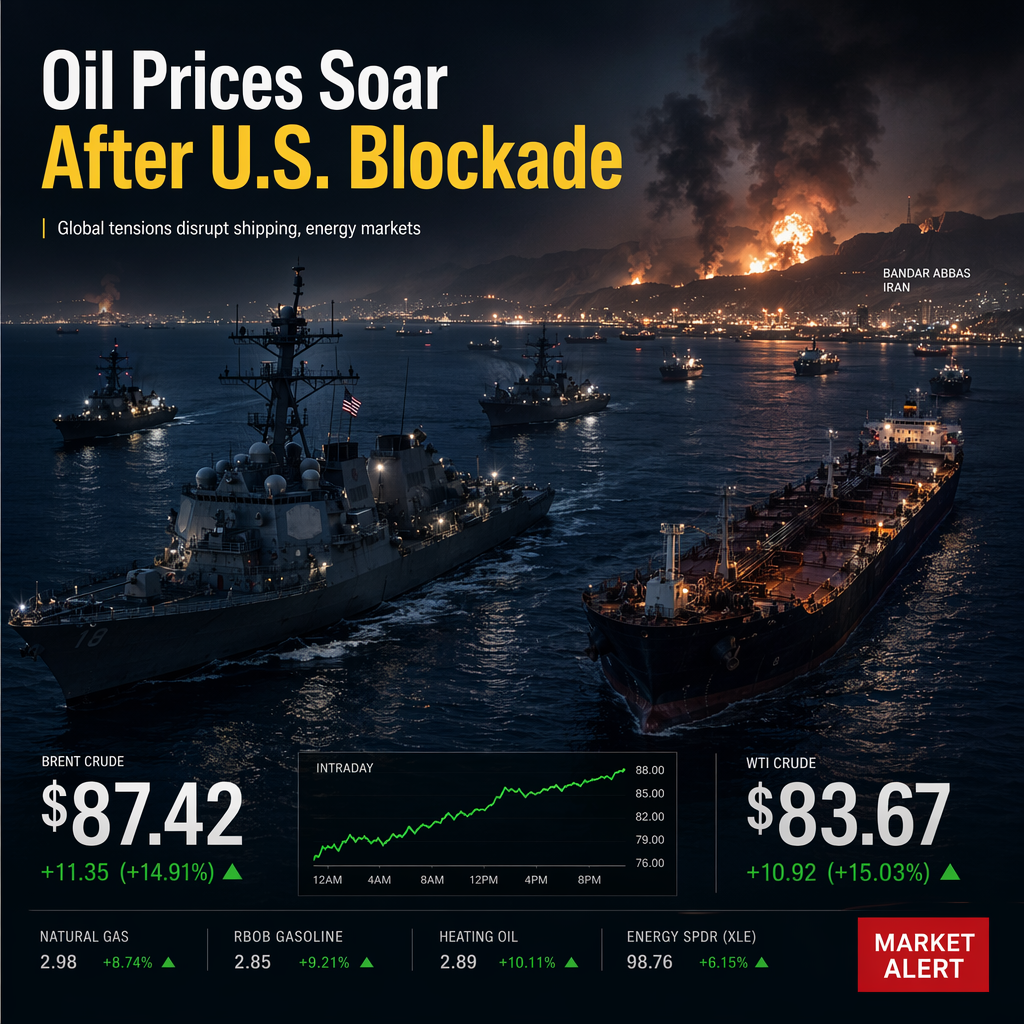
Global oil prices surged sharply following a series of U.S. military strikes on Iran and the announcement of a renewed U.S. naval blockade targeting Iranian ports and vessels in the Strait of Hormuz. On Tuesday, the international oil benchmark Brent rose for a second consecutive day, surpassing $87 per barrel for the first time since June, while U.S. crude oil climbed more than 4% from Monday to exceed $81 per barrel. Since Sunday night, Brent has increased by over 15% and U.S. crude by more than 12% [1].
The U.S. Central Command reported that its forces conducted five hours of strikes on Iranian military targets across several locations, including Bushehr, Chah Bahar, Jask, Konarak, Abu Musa, and Bandar Abbas, aiming to degrade Iran's capacity to attack commercial shipping [1]. The U.S. blockade on Iran's coastline, ports, and all Iranian-associated vessels in the Strait of Hormuz is set to take effect at 4:00 p.m. ET (12:30 a.m. Wednesday in Tehran) [1]. ING commodities analysts noted that the return of the U.S. blockade is significantly more impactful for markets than the previous suspension of the sanction waiver on Iranian oil, and suggested that the Memorandum of Understanding signed in mid-June between Trump and Iran appears to be defunct [1].
Shipping traffic through the Strait of Hormuz has declined sharply amid the renewed conflict and security concerns. Data from Kpler shows that vessel transits dropped from 19 on Friday and 24 on Saturday to just 10 on Monday, reflecting heightened risk perceptions among commercial shippers [1]. ING analysts commented that despite U.S. assurances that the strait remains open, the risk of attack has deterred shipping activity [1].
Additionally, President Donald Trump announced that the U.S. would seek to be "reimbursed" for protecting ships in the strait, proposing a fee of 20% on all cargo shipped. This proposal was criticized by International Maritime Organization Secretary General Arsenio Dominguez, who stated there is no legal basis for mandatory tolls for passage through a strait, and by shipping company Hapag-Lloyd, which called such fees fundamentally wrong [1].
CONCLUSION
The combination of U.S. military action against Iran, the imminent blockade of Iranian shipping, and proposed new shipping fees has driven oil prices sharply higher and disrupted commercial traffic through the Strait of Hormuz. Market sentiment is negative, with analysts highlighting the significant impact of these developments on global energy markets and shipping security.