
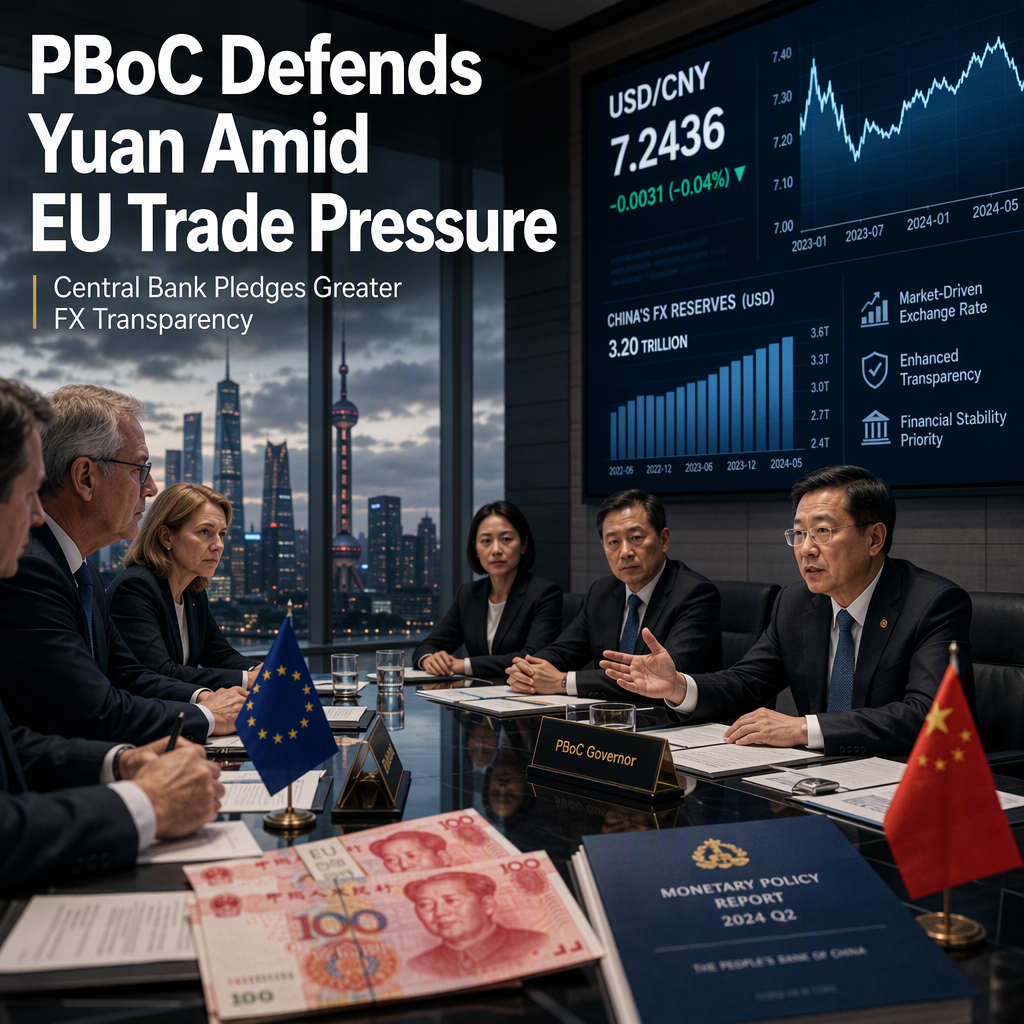
The People’s Bank of China (PBoC) has issued a policy paper firmly rejecting claims that the Chinese yuan is undervalued, attributing the country's export strength to industrial competitiveness rather than currency manipulation [1]. This statement coincided with the start of two days of talks between EU trade officials and their Chinese counterparts, as Brussels increasingly frames bilateral trade imbalances as a currency issue [1]. The PBoC’s move is seen as an effort to shape the narrative ahead of any formal demands for exchange rate adjustments from the European side [1].
The central bank emphasized that there is no linear relationship between the exchange rate and the current account balance, noting that previous periods of yuan depreciation did not lead to accelerated gains in China’s export market share [1]. In a gesture towards greater transparency, the PBoC announced that China will begin reporting foreign exchange operation data to the IMF starting in 2027, addressing longstanding calls from international institutions [1].
On the market front, USD/CNY fell by 30 pips to 6.70, while USD/CNH remained largely unchanged at 6.70 [1]. China’s foreign exchange reserves declined to USD 3.40 trillion at the end of September, down from USD 3.44 trillion at the end of August, partly due to valuation effects from weaker gold prices during the month (Bloomberg consensus: USD 3.43 trillion) [1]. Credit demand in China remains sluggish, and the current investment-led policy push has yet to generate a broader economic rebound [1].
The timing of the PBoC’s announcement is notable, as it comes amid escalating trade tensions with Europe. France and Germany are reportedly urging the European Commission to adopt more assertive protective measures against Chinese export dominance, reflecting a broader global pushback [1].
CONCLUSION
The PBoC’s rejection of undervaluation claims and its commitment to increased FX transparency signal a strategic response to rising EU trade pressures. While the yuan saw a modest move and reserves declined, the central bank’s stance aims to preempt formal demands for currency adjustment. Market participants are likely to view these developments as a measured but significant step in ongoing China-EU trade relations.