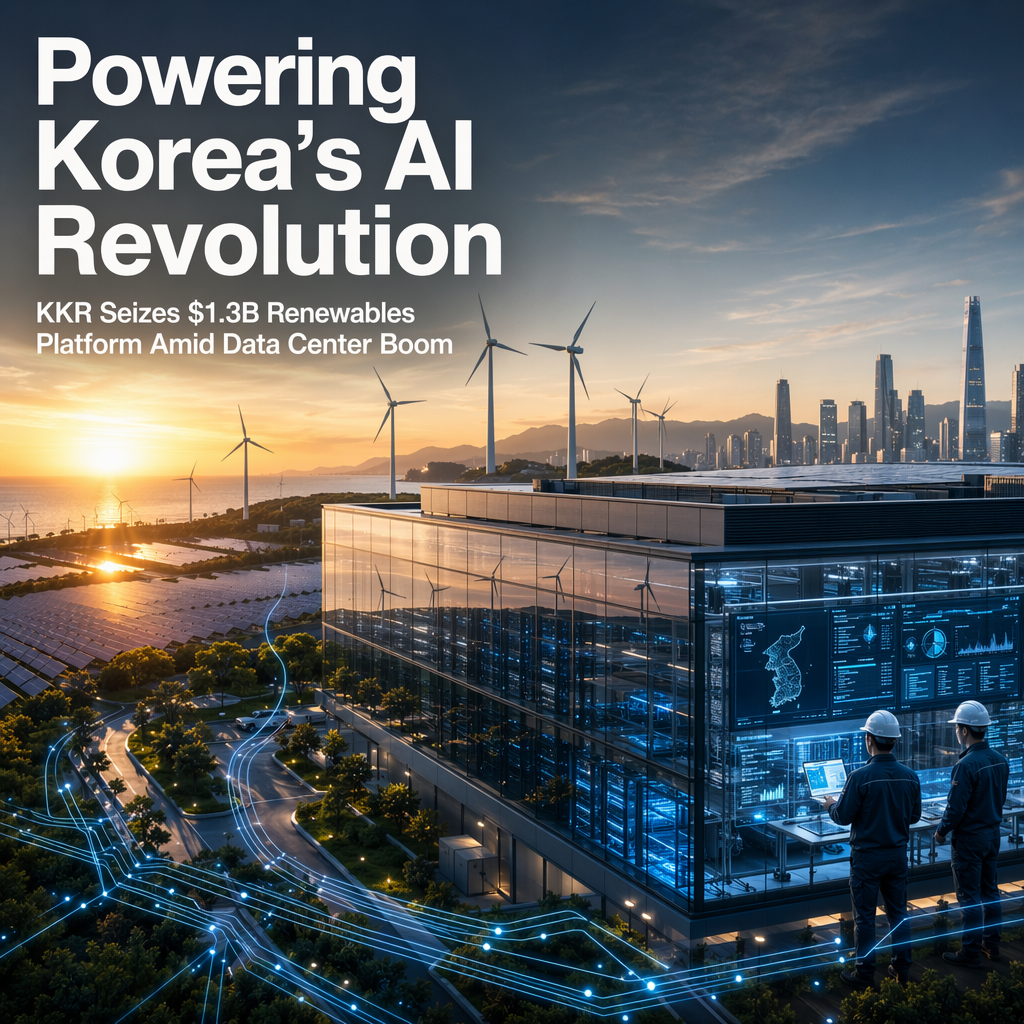
KKR, a U.S. private equity firm, will assume management control of a new $1.3 billion renewable energy platform in South Korea, in partnership with SK Inc. The platform, valued at 2 trillion won ($1.3 billion), will integrate wind, solar, and fuel cell assets previously held across SK Group's businesses, including SK Innovation, SK ecoplant, and SK eternix [1]. The venture will launch with 1.7 gigawatts of operating capacity and aims to scale up to 10 gigawatts, which the companies state is sufficient to power 100 large-scale, 100-megawatt data centers simultaneously [1].
This initiative is designed to address the surging demand for clean power from AI data centers, semiconductor production lines, and other large industrial needs in South Korea. The announcement follows South Korea's recent unveiling of three major investment projects in semiconductors, physical AI, and AI data centers. SK Group, the country's second-largest conglomerate, has announced plans to invest an average of 100 trillion won annually to expand semiconductor production and build AI data centers [1].
KKR will hold initial management control, while SK will participate as an equity investor and retains the option to seek control rights through future negotiations. The deal is being funded through KKR's Asia Pacific infrastructure strategy, which has invested over $31 billion in energy transition and renewables globally since 2011. The Korea platform adds to KKR's renewable energy investments in the region, including stakes in Serentica Renewables (India), CleanPeak Energy, and Zenith Energy (Australia) [1].
SK Group's participation in the platform is part of its ongoing 'value-up plan,' which includes asset sales and restructuring to reduce debt leverage. The company stated that the platform is a component of its broader strategy to sharpen its portfolio and improve capital efficiency [1].
CONCLUSION
KKR's acquisition of management control over South Korea's largest renewable energy platform marks a significant step in meeting the country's growing demand for clean power, particularly from AI and semiconductor sectors. The deal underscores both KKR's and SK Group's commitment to energy transition and portfolio optimization, with substantial investments planned to support South Korea's industrial and technological expansion.