
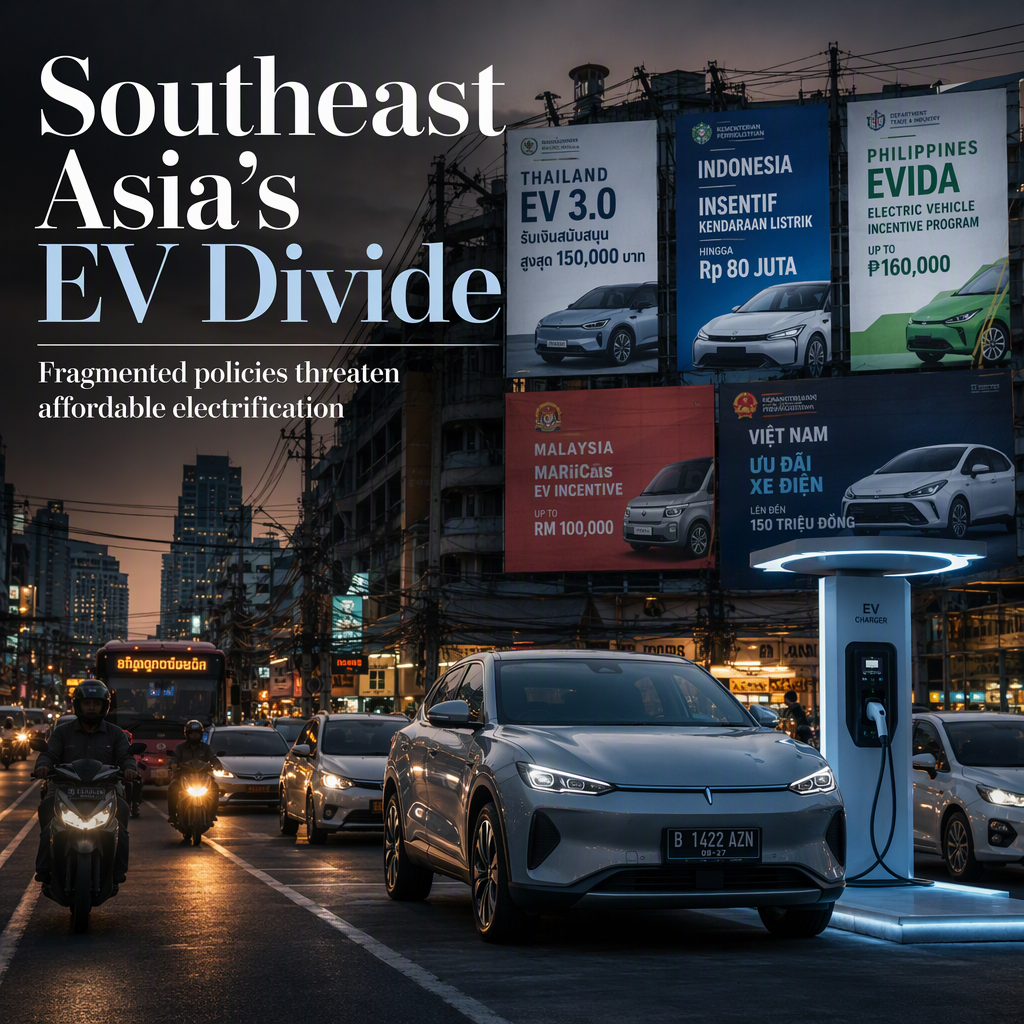
Southeast Asia's push to become a major electric vehicle (EV) manufacturing hub is resulting in a fragmented and costly market, according to industry observers and analysts. Despite aggressive governmental support, including tax incentives and local content requirements, each country in the region is pursuing its own strategy to attract foreign direct investment and build domestic manufacturing capacity. This has led to a patchwork of standards, incentives, and requirements that complicates cross-border trade and increases costs for both manufacturers and consumers [1].
The average price gap between EVs and internal combustion engine (ICE) vehicles in Southeast Asia remains significant, making it difficult for most consumers—especially in price-sensitive markets—to justify switching to EVs. As a result, EV ownership is largely concentrated among wealthier urban consumers, leaving rural and lower-income populations behind. This trend undermines the social and environmental benefits that widespread EV adoption could bring to the region [1].
Industry analysts warn that unless governments harmonize standards and lower barriers, the region risks pricing out the very consumers who are meant to benefit from the EV transition. The focus on attracting major automakers and battery producers has led to local assembly requirements, import duties on components, and restrictions on foreign competition, all of which raise production costs and limit economies of scale [1].
Experts suggest that greater regional coordination on EV standards, charging infrastructure, and incentive programs is necessary to avoid a fragmented market that is both costly and inaccessible to most drivers. Without such collaboration, Southeast Asia's ambitions for EV growth may be undermined, potentially hurting the long-term development of the sector [1].
CONCLUSION
Southeast Asia's fragmented approach to EV development is increasing costs and limiting accessibility for most consumers. Without regional coordination and harmonized policies, the region risks undermining its own EV adoption goals and the broader benefits of electrification.