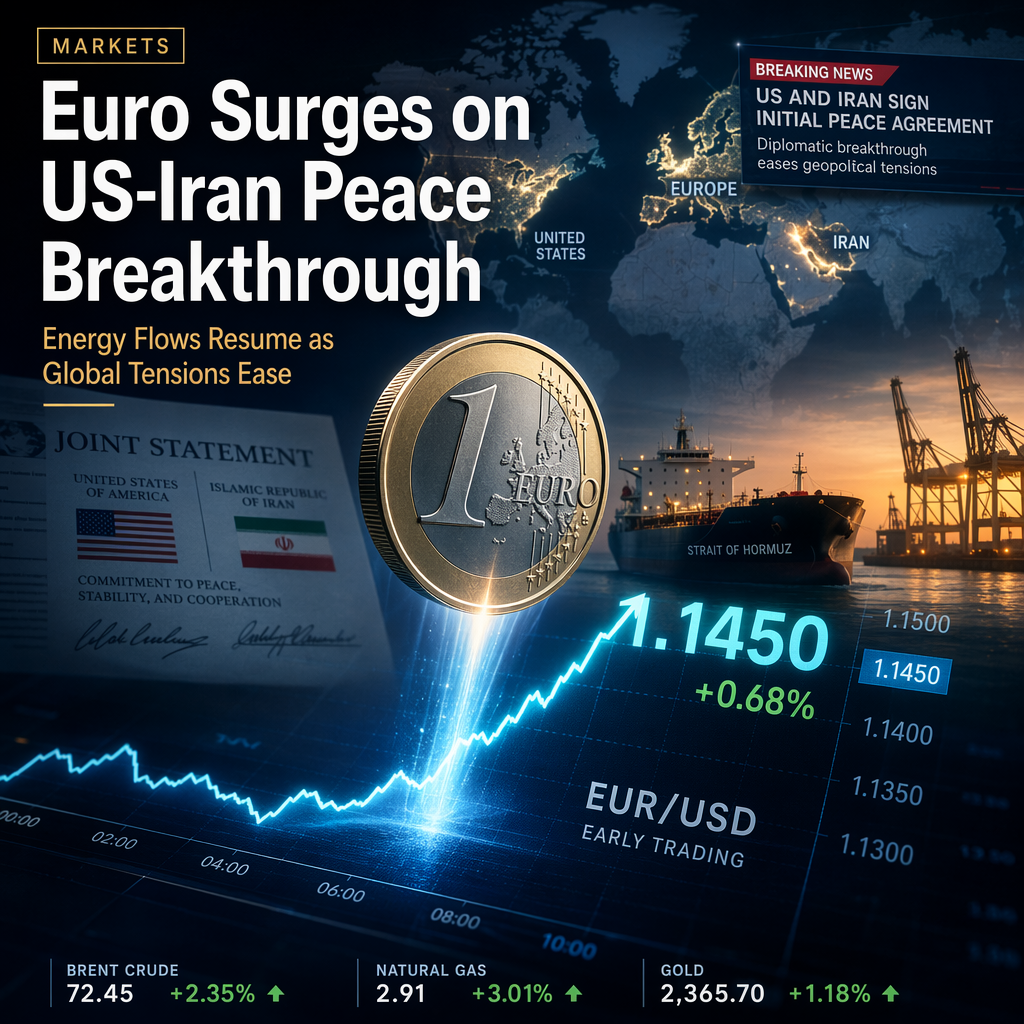
The EUR/USD currency pair recovered some lost ground, trading near 1.1460 during the early Asian session on Friday, after snapping a two-day losing streak. This upward movement in the Euro was attributed to the signing of an initial agreement between US President Donald Trump and Iran to end the war that has disrupted global energy supplies. The agreement initiates 60 days of negotiations toward a final deal to end the conflict, according to CNN. Additionally, the US military confirmed it had ended its blockade on Iranian ports near the Strait of Hormuz, allowing millions of barrels to flow through the vital waterway once again. These positive developments surrounding the US-Iran peace deal are expected to boost riskier assets, including the Euro, in the near term [1].
On the monetary policy front, the Federal Open Market Committee (FOMC) voted unanimously to keep its benchmark overnight borrowing rate unchanged in a range of 3.5%-3.75% on Wednesday. During the press conference, new Chairman Kevin Warsh emphasized that 'price stability' would be the Fed’s guiding principle. The Fed's hawkish hold could potentially strengthen the US Dollar and create a headwind for the EUR/USD pair. Futures traders are now pricing in a quarter-percentage-point rate hike at the Fed's September meeting, with some probability of a move as soon as next month’s meeting [1].
The Euro is the currency for 20 European Union countries in the Eurozone and is the second most heavily traded currency globally, accounting for 31% of all foreign exchange transactions in 2022. The EUR/USD pair is the most heavily traded currency pair, representing an estimated 30% of all transactions. The European Central Bank (ECB) manages monetary policy for the Eurozone, with its primary mandate being price stability. Eurozone inflation data, measured by the Harmonized Index of Consumer Prices (HICP), is a key metric for the Euro, as higher-than-expected inflation obliges the ECB to raise interest rates [1].
CONCLUSION
The Euro's rise above 1.1450 was driven by positive geopolitical developments between the US and Iran, which eased concerns over global energy supply disruptions. However, the Fed's hawkish stance and potential rate hikes could pose challenges for further Euro gains. Market participants will closely monitor ongoing US-Iran negotiations and upcoming Fed decisions for future direction.