
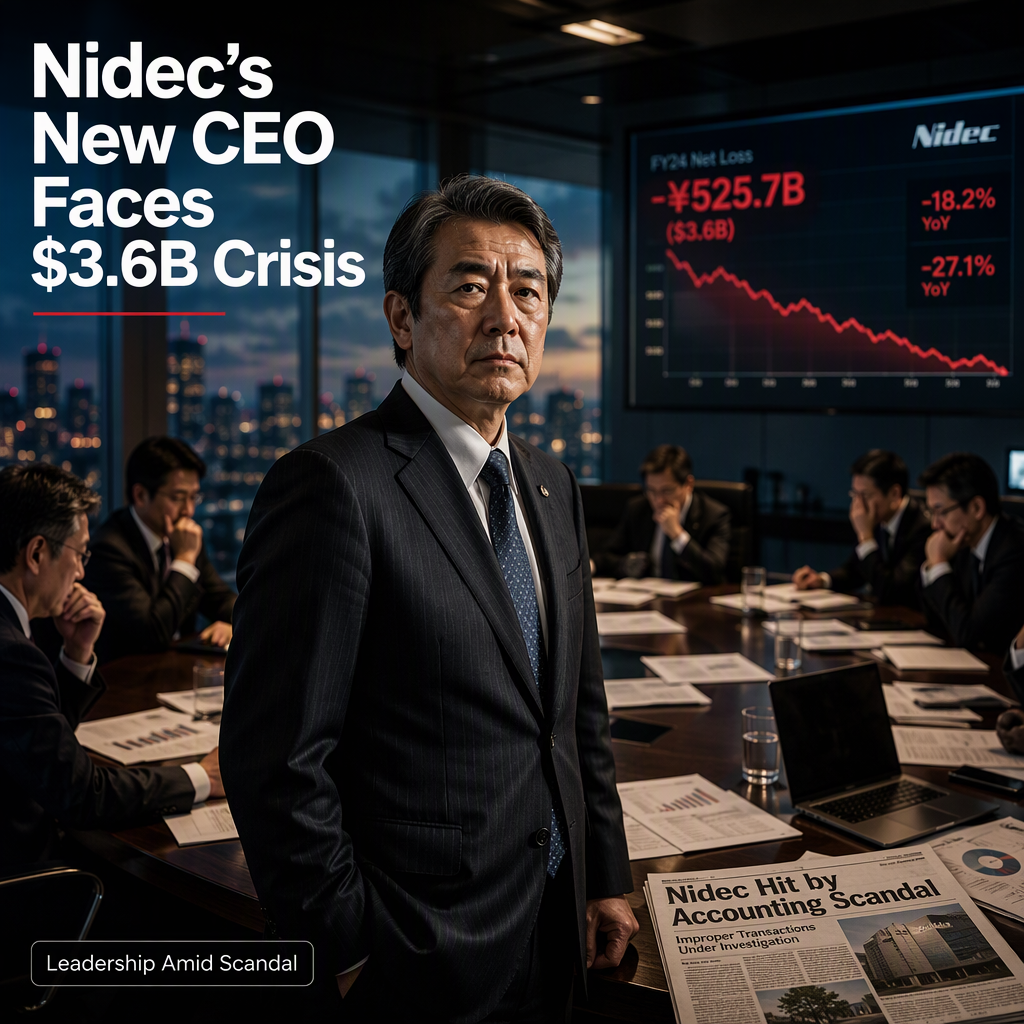
Nidec, the Japanese motor manufacturer, has appointed Michio Kaida as its new President and CEO following a significant accounting scandal that has left the company on the brink of delisting [1]. The company recently disclosed billions of dollars in impairment losses, including a $3.6 billion loss on EV motor write-downs, highlighting the severity of its financial troubles [1]. The scandal has raised questions about whether Kaida, who has been long praised by founder Shigenobu Nagamori, will represent a true departure from past leadership practices [1].
Industry observers have noted Kaida's determination, but there is skepticism regarding his willingness or ability to implement substantial changes necessary to restore governance and financial stability at Nidec [1]. In response to the crisis, Nidec is taking steps to shore up its governance, including the sale of its electronic parts unit to Carlyle as part of a broader restructuring effort [1]. The company's auditor has withheld sign-off on earnings, further intensifying the urgency for governance reforms [1].
Market sentiment has been negatively affected, with Nidec's share price coming under pressure as investors react to the scale of the losses and uncertainty surrounding the company's future leadership and direction [1]. The Japanese government is also taking action, moving to place greater responsibility for preventing accounting fraud on top executives, a move seen as a direct response to the Nidec scandal [1].
Additionally, Nidec has confirmed 'suspected improper conduct' related to quality irregularities, compounding concerns about operational controls and oversight within the company [1]. The new CEO faces the formidable challenge of restoring credibility, improving capital efficiency, and ensuring compliance with stricter regulatory requirements [1].
CONCLUSION
Nidec's leadership change comes amid severe financial and governance challenges, with billions in losses and heightened regulatory scrutiny. The company's future hinges on the new CEO's ability to restore trust, implement reforms, and navigate a difficult market environment.