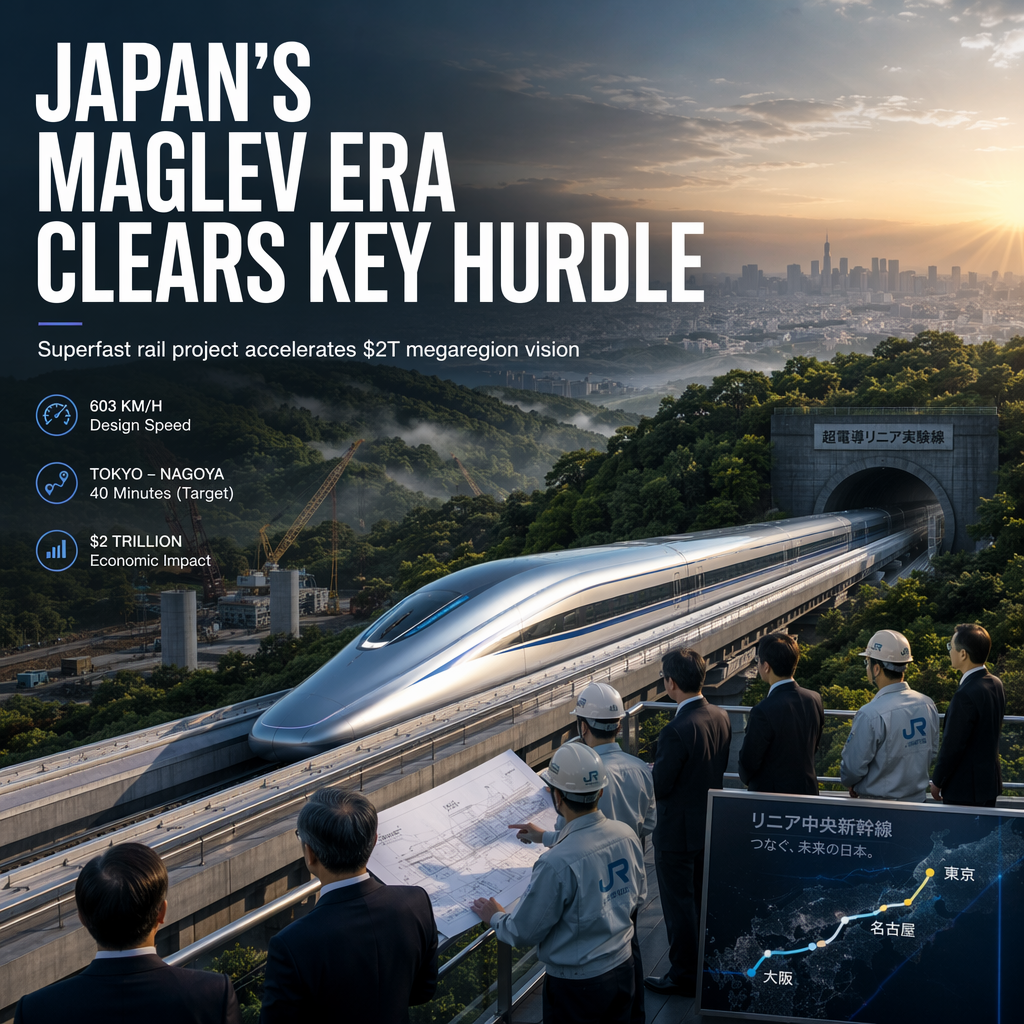
Japan's ambitious plan to construct an ultra-fast maglev train line connecting Tokyo, Nagoya, and Osaka has taken a significant step forward following the approval from a local governor, a move that has heightened public-private sector optimism for the creation of a new economic corridor valued at $2 trillion and home to 66 million people [1]. The Linear Chuo Shinkansen, spearheaded by Central Japan Railway (JR Central), is designed to cut travel times between these major cities to just over an hour, less than half the current fastest options, which range from two and a half to three hours on the existing Shinkansen [1].
The project is expected to have substantial economic impacts, enhancing business connectivity and stimulating regional development across Japan's central corridor [1]. Both public and private sectors are backing the initiative, with expectations that the new line will boost population mobility and transform the economic landscape of the region [1].
However, the maglev project has faced notable challenges, including environmental concerns, significant construction cost overruns—reportedly around $26 billion—and uncertainties regarding the official start date [1]. These issues have raised questions about the project's financial feasibility and timeline, though the recent approval is seen as a major milestone that renews momentum for further construction [1].
Industry analysts suggest that the successful completion of the Linear Chuo Shinkansen could position Japan as a leader in maglev technology, potentially opening up export opportunities for Japanese rail operators and technology providers [1]. Stakeholders are closely monitoring the project's progress, given its potential to serve as a model for similar infrastructure initiatives worldwide [1].
CONCLUSION
The recent local governor's approval marks a turning point for Japan's maglev project, signaling renewed momentum despite ongoing financial and environmental challenges. If completed, the Linear Chuo Shinkansen is expected to reshape Japan's central corridor, boost economic activity, and enhance the country's position in high-speed rail technology.