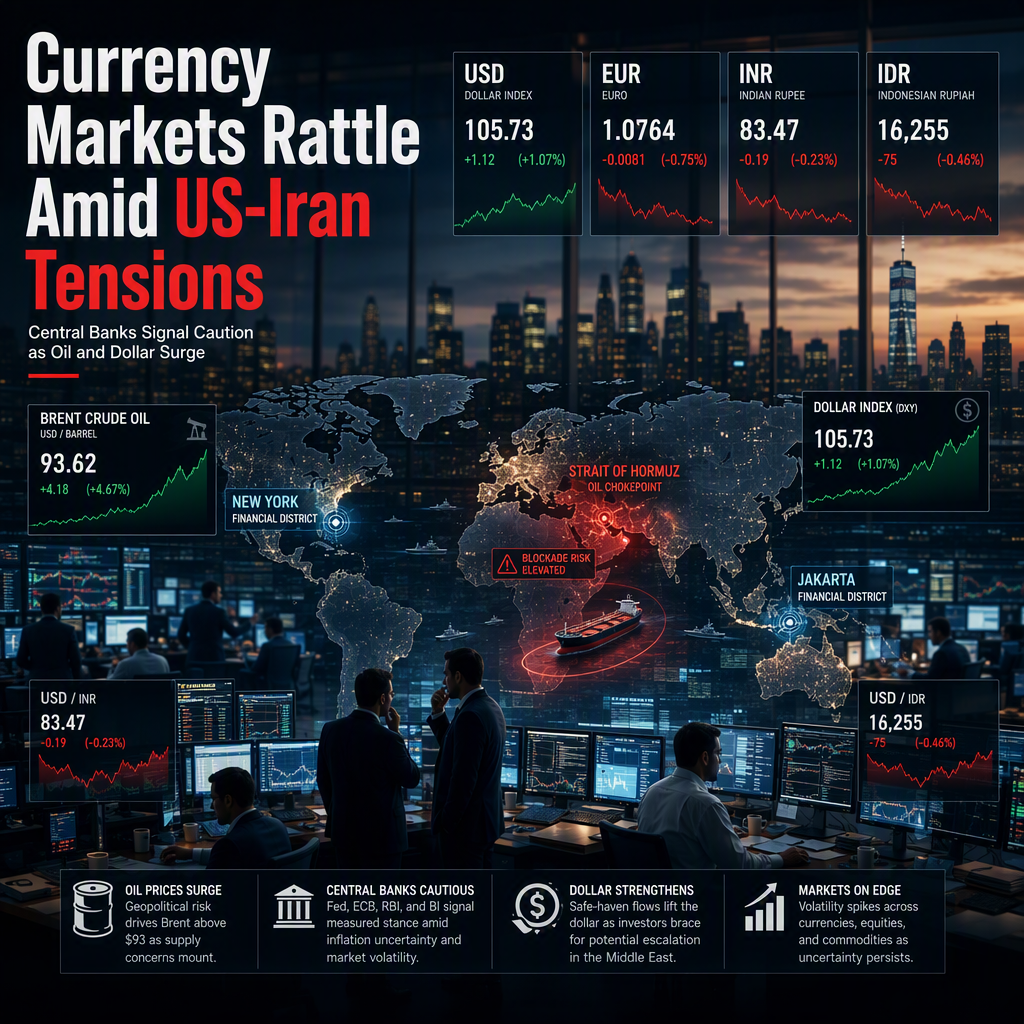
The US Dollar (USD) has experienced volatility across major currency pairs as geopolitical tensions between the United States and Iran escalate, particularly following US President Donald Trump's statement that he is not interested in renewing the expiring agreement with Iran and citing the US naval blockade on Iranian seaports as leverage [1][2][3]. This has prompted fears of renewed military conflict and potential disruptions in energy supply, notably impacting oil prices, which rallied 1.1% to Rs. 8,150 in India, the highest level in two weeks [2]. The closure of the Strait of Hormuz was reported by UK Maritime Trade Operations (UKMTO), with a vessel struck by an unknown projectile, further intensifying market caution [3].
In Indonesia, the Rupiah (IDR) remains weak, with USD/IDR trading around 17,900 during Asian hours on Tuesday. The currency's softness is attributed to cautious sentiment ahead of Bank Indonesia’s (BI) two-day policy meeting, where strategists widely expect BI to keep its benchmark rate unchanged at 5.75% under acting Governor Destry Damayanti, following a cumulative 100 basis points in rate hikes between May and June [1]. Economists at UOB Group note Indonesia’s 2027 fiscal plan targets 6.0% economic growth and a fiscal deficit narrowing to 2.40% of GDP, aiming for momentum with fiscal discipline [1].
The Indian Rupee (INR) edged up against the USD, with USD/INR trading near 95.67 after hitting a three-week high at 95.85. The INR's slight strength is attributed to possible Reserve Bank of India (RBI) intervention, as state-run banks were seen offering dollars, likely on behalf of the RBI, for an eighth consecutive session [2]. Elevated oil prices continue to pressure the INR, given India's reliance on energy imports [2]. Technical analysis shows USD/INR holding above the 100-day SMA at 95.0046, with a moderately bullish bias and immediate support at 95.67 [2].
The Euro (EUR) declined below 1.1600 against the USD, trading around 1.1575, as traders remain cautious about the US-Iran conflict and the closure of the Strait of Hormuz [3]. Despite these headwinds, strategists at Scotiabank highlight Eurozone resilience and narrowing yield spreads with the US as supporting factors for the EUR [3]. Technical analysis indicates EUR/USD maintains a modest bullish bias above key moving averages, with resistance at 1.1642 and support at 1.1570 [3].
Across all markets, expectations for a September Federal Reserve (Fed) rate hike have diminished following soft US economic data, including a decline in July Nonfarm Payrolls and Retail Sales, as well as tame inflation figures. The CME FedWatch tool shows the probability of a Fed rate hike at the next meeting has fallen to 35%, down from 47% a month ago [1][2][3].
CONCLUSION
Geopolitical tensions between the US and Iran, combined with soft US economic data and shifting central bank policy signals, have led to volatility in global currency markets. While the USD has seen safe-haven flows, diminished Fed rate hike expectations and central bank interventions in India and Indonesia have shaped currency movements. Market participants remain cautious, awaiting further policy guidance and developments in the US-Iran conflict.