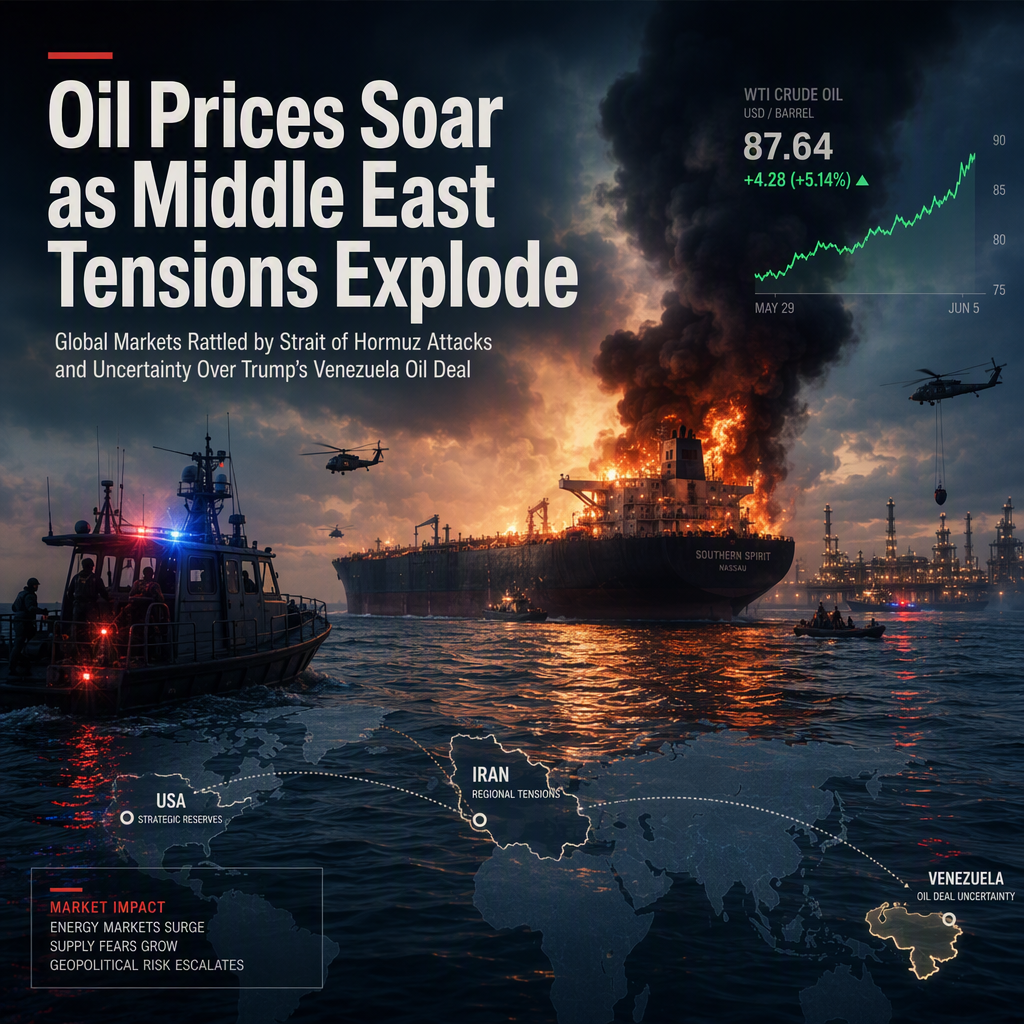
West Texas Intermediate (WTI) crude oil prices have climbed for the second consecutive day, trading around $85.60 per barrel during Asian hours on Tuesday, as renewed hostilities in the Middle East threaten global energy supply chains [1]. The escalation follows US military strikes on Iranian rocket launchers on Larak Island, which prompted retaliatory attacks by Tehran on US bases in Jordan [1][2][3]. President Donald Trump has warned of potential military action against Kharg Island, Iran's primary oil export hub, further intensifying geopolitical risks [1][2].
A supertanker caught fire after striking naval mines in the Strait of Hormuz, a critical maritime route, raising concerns about supply disruptions. Despite these hazards, major Gulf producers such as Saudi Arabia, the UAE, Kuwait, and Iraq continue to ship partial volumes through the strait [1][2]. The UK Maritime Trade Operations agency confirmed that a tanker was struck by three unknown projectiles near the Omani coast, with no casualties reported [2]. Iran's Islamic Revolutionary Guard also reported intercepting a US MQ-9 drone over the eastern Strait of Hormuz [2].
The ongoing conflict, now in its seventh month, has disrupted global energy supplies and sent shockwaves through financial markets [2]. Compounding these pressures, drone and missile strikes on Russian refineries have reduced refining capacity, driving refined-product margins to record highs [1]. US Treasury Secretary Scott Bessent stated that Iran is "lashing out kinetically" due to the impact of new US sanctions, which are taking a toll on Iran's economy [2][3].
President Trump has claimed that the US has secured majority control over more than 65 billion barrels of oil reserves in Venezuela, framing the deal as coming at "no cost" to US taxpayers and promising it will lower gasoline prices and strengthen bilateral ties [1][3]. However, experts cited by CNBC note that Venezuela's oil infrastructure is severely degraded, requiring about $180 billion in investment until 2040 to restore peak production, and that the deal is unlikely to lower gas prices in the near term [3]. US pump prices averaged $4.08 per gallon on Monday, nearly 30% higher than a year ago [3]. Trump plans to meet with US refiners and fuel distributors to expand domestic refining capacity [3].
Analysts view the US attack on Larak Island as an attempt to break a deadlock rather than a shift in strategy, with the Trump administration aiming to degrade Iran's ability to mine the Strait of Hormuz while focusing on economic measures [2]. Trump continues to push for lower interest rates from the Federal Reserve, arguing for rapid economic growth, though experts question the feasibility of his projections [3].
CONCLUSION
WTI oil prices have surged amid escalating Middle East tensions and supply disruptions, with additional uncertainty stemming from President Trump's claimed Venezuela oil deal. While Trump promises lower gasoline prices, experts caution that infrastructure challenges in Venezuela mean benefits are unlikely to materialize soon. The ongoing conflict and sanctions continue to exert significant pressure on global energy markets, resulting in high volatility and elevated prices.