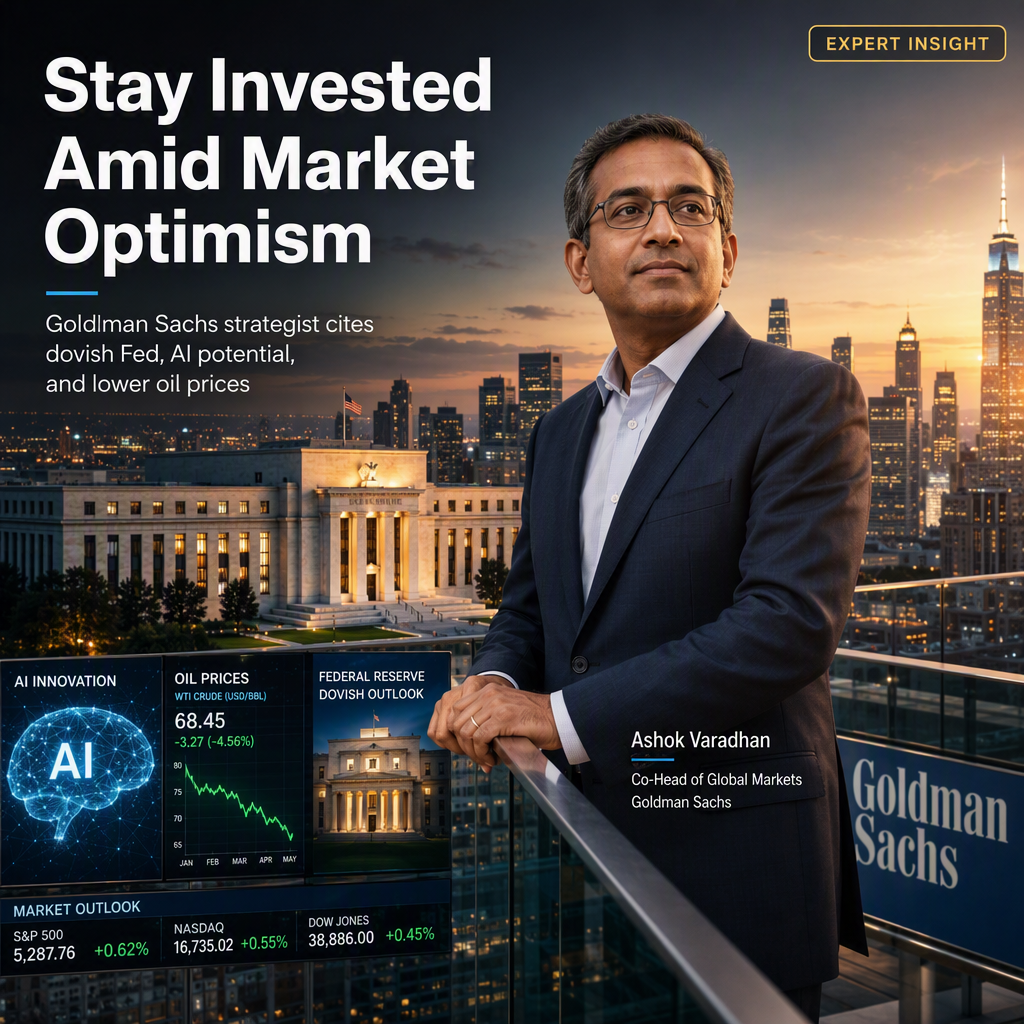
Goldman Sachs' co-head of global banking and markets, Ashok Varadhan, has advised investors to remain invested in the market despite recent events that have raised concerns among market participants. Varadhan outlined three primary reasons for his constructive stance: a dovish outlook on interest rates, the potential for artificial intelligence (AI) to drive disinflation, and expectations for oil prices to fall well below $70 a barrel later in 2026 [1].
Varadhan does not anticipate the Federal Reserve will raise interest rates this year, a view that contrasts with market pricing, which has reflected some risk of resumed tightening due to lingering inflation concerns. He stated, "I don't think we will see hikes in the latter part of this year. I think rates are going to stay on hold" [1]. Following a disappointing jobs report, traders adjusted their expectations, with the odds for a rate hike in September dropping to around 50% and rising to 63% for October, according to the CME Group's FedWatch gauge [1].
On inflation, Varadhan noted that some of the forces that previously pushed prices higher, such as tariffs, are beginning to recede. He also highlighted that easing geopolitical tensions around the Strait of Hormuz could further reduce price pressures. While the infrastructure buildout for AI may contribute to inflation in the near term, Varadhan believes the long-term productivity benefits of AI will act as a disinflationary force [1].
Regarding energy markets, Varadhan expects crude oil prices to decline significantly, predicting that oil will settle well below $70 a barrel by the latter part of the year. This outlook comes despite West Texas Intermediate futures recently climbing above $80 per barrel amid uncertainty over U.S.-Iran negotiations affecting ship traffic through the Strait of Hormuz [1].
Varadhan's third pillar of optimism is the resilience of the economy. He emphasized that, despite a series of external shocks, underlying nominal growth has remained durable. If some of these pressures fade, the economy could continue to expand, further benefiting from AI-driven productivity improvements [1].
CONCLUSION
Goldman Sachs' Ashok Varadhan maintains a positive outlook for investors, citing a dovish Fed, the disinflationary potential of AI, and expectations for lower oil prices. Despite some market uncertainty, Varadhan's advice is to stay invested, as he sees continued economic resilience and opportunities for growth ahead.