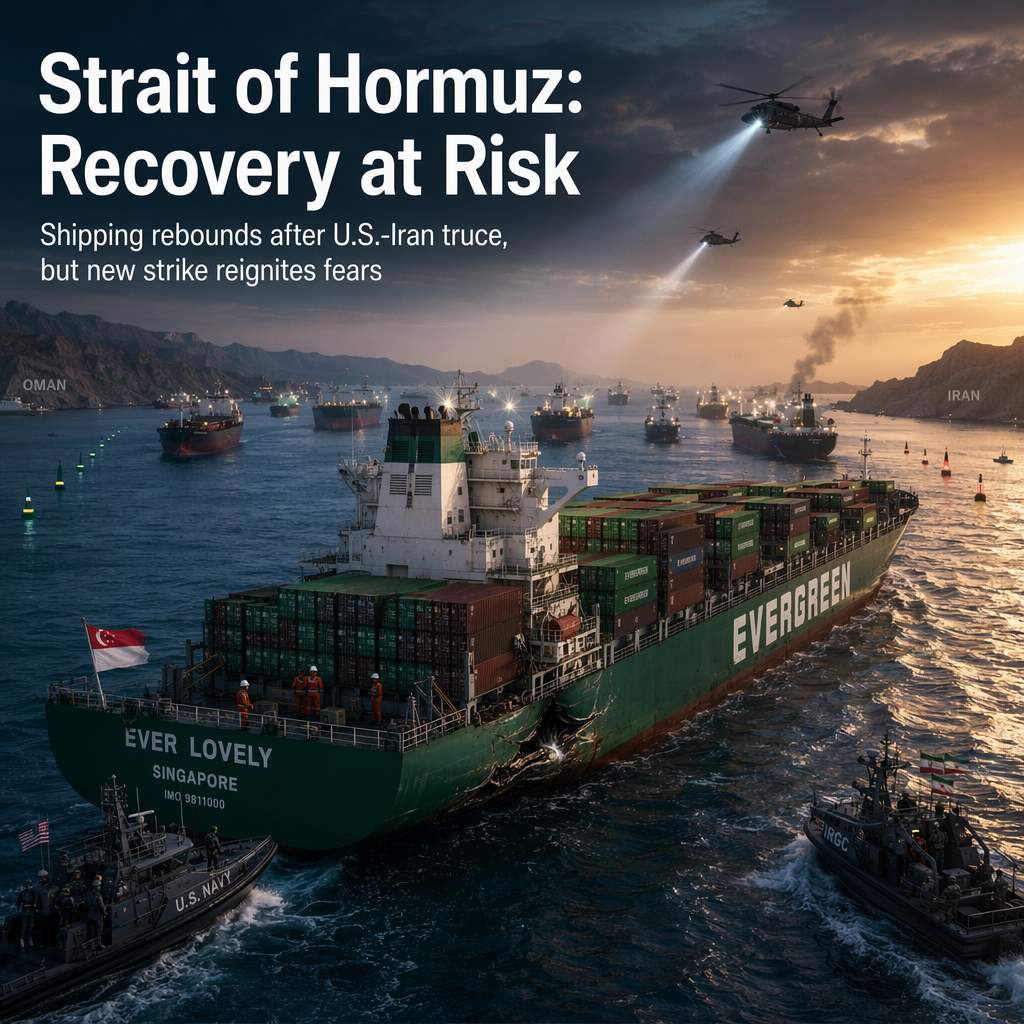
Shipping traffic through the Strait of Hormuz has shown signs of recovery one week after the U.S. and Iran signed an interim peace deal aimed at reopening the critical waterway. Between June 15-21, 125 vessel transits were recorded, the highest weekly total since the war began in late February, as tankers rushed to move stored Gulf crude before the 60-day truce window expires [1]. On June 24, AXS Marine reported 62 commercial vessel crossings, marking the highest single-day count since the conflict started, though this figure represents only 53% of the traffic seen on the same day last year [1].
Despite the rebound, the situation remains precarious. On Thursday, a cargo ship, the Ever Lovely—a Singapore-flagged Evergreen container vessel—was struck by a projectile off the Omani coast, in what a U.S. official attributed to the Islamic Revolutionary Guard Corps (IRGC). This was the first attack on a cargo vessel since the ceasefire took effect and has reignited concerns over the safety of the passage, halting the United Nations' evacuation plan and causing some tankers to reverse course [1].
The IRGC has mandated that all ships use only its northern route and comply with Iranian routing instructions, while the U.S. and Oman support a separate southern corridor with Omani navigational guidance and American naval oversight. The standard pre-war commercial lane remains closed due to mines, leaving shipowners to navigate between two competing authorities and no agreed rules [1]. Iran has warned it will take action against ships not using its northern route or coordinating with Iranian authorities [1].
Industry voices highlight the ongoing uncertainty. Tim Huxley, CEO of Mandarin Shipping, stated, "Until there is a more concrete set of guidelines on safe navigation, people are going to be very reticent to go through" [1]. Companies face a difficult choice: risk transiting the Strait or hold back and potentially lose business to rivals willing to take the risk. Bruce Tan, a Singapore-based electronics manufacturer, resumed shipments through the corridor but only in small batches, citing concerns about a potential closure [1].
The Strait of Hormuz, located between Oman and Iran, typically handles around 20% of the world's oil traffic, underscoring the global significance of the ongoing instability [1].
CONCLUSION
While shipping activity in the Strait of Hormuz has rebounded following the U.S.-Iran interim peace deal, the recent attack on a cargo vessel underscores the fragility of the recovery. Persistent security risks and competing navigation authorities continue to cloud the outlook, leaving market participants cautious and the energy supply chain vulnerable.