
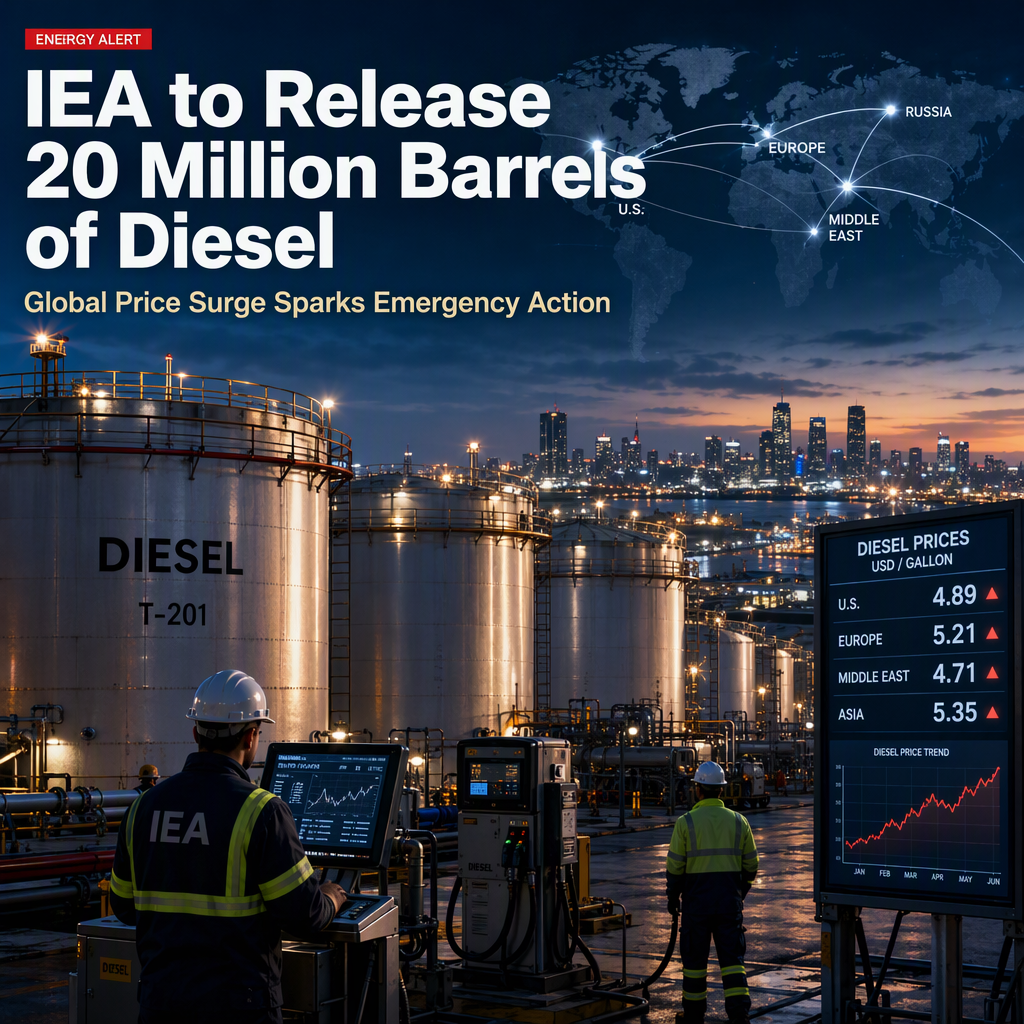
The International Energy Agency (IEA) announced that its members will release more than 20 million barrels of diesel 'as soon as possible' in response to surging global fuel prices [1]. This release, detailed in a Thursday statement, is equivalent to less than one day of global diesel demand or slightly more than five days of U.S. consumption [1]. The IEA did not specify an exact timeline for the release, but the Group of Seven nations led by France previously indicated plans to deploy substantial diesel stocks over 20 days, which would equate to about 1 million barrels per day for nearly three weeks if followed by the IEA [1].
Diesel futures reacted to the news, trading more than 1% lower on Thursday at $4.86 [1]. Meanwhile, the average retail price of diesel in the U.S. stood at $6.32 per gallon, over 70% higher than the same period last year, according to AAA [1]. President Donald Trump has pressured Europe to release diesel inventories as U.S. prices reached record highs in September, and he recently struck a diesel deal with Russia, though analysts believe it will have minimal impact on prices [1].
The IEA's governing board also reported that, out of the 400 million barrels of oil agreed for release in March in response to supply disruptions from the Iran war, 330 million barrels have already been deployed, with some members exceeding their original pledges. The remaining 100 million barrels are set to be released 'in a timely manner consistent with national circumstances' [1].
Despite the diesel release, Andy Lipow, president of Lipow Oil Associates, stated that this action 'does not solve the basic problem which is how to increase production at refineries which are damaged in the Middle East or Russia, and operating at capacity in the USA' [1]. Prices have surged due to attacks on Russian refineries by Ukraine and energy facility strikes in the Persian Gulf by Iran and its Houthi allies [1].
CONCLUSION
The IEA's decision to release over 20 million barrels of diesel aims to address soaring global fuel prices, but market reactions suggest limited immediate relief. Analysts highlight that the fundamental issue lies in refinery production constraints, not just supply, indicating ongoing volatility in diesel markets.