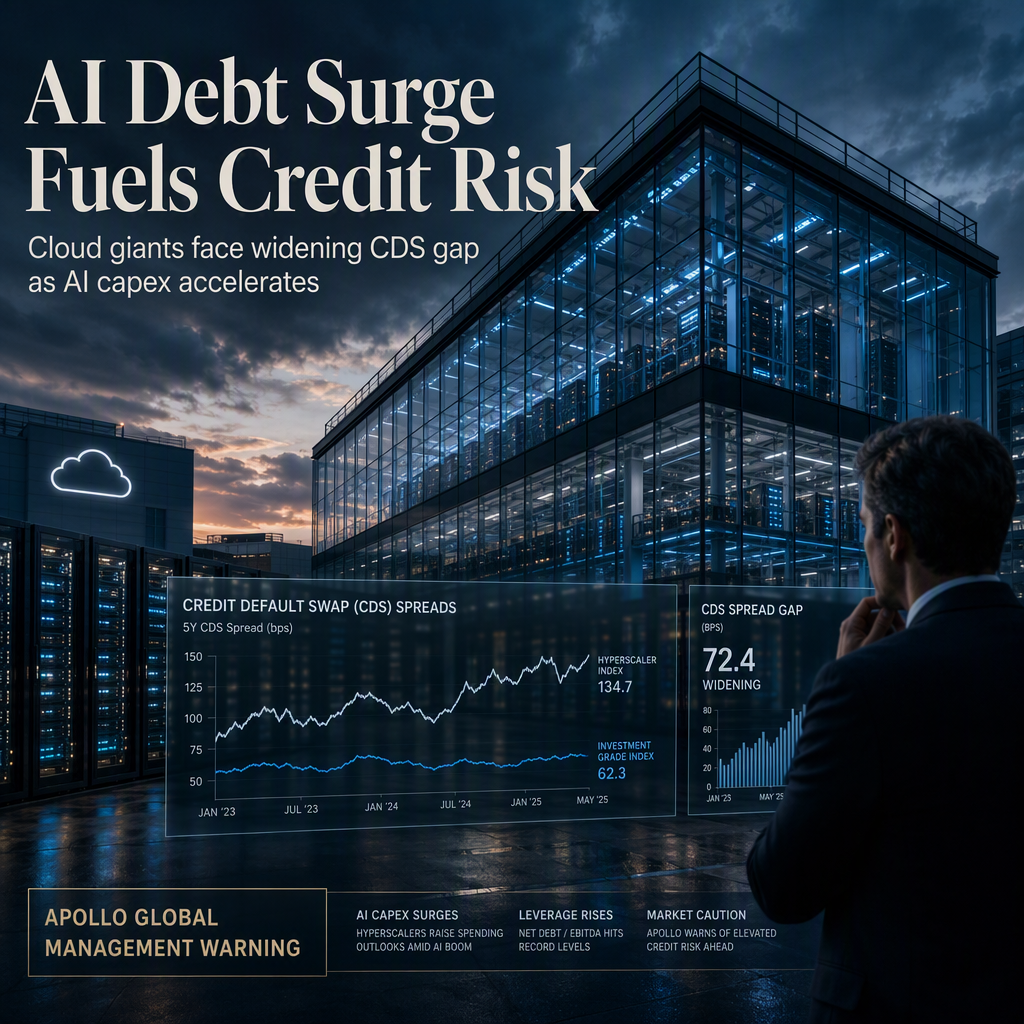
Apollo Global Management issued a warning on September 16, 2026, highlighting that credit default swaps (CDS) for hyperscaler debt have become more expensive, signaling increased risk in bonds issued by major cloud computing companies powering the artificial intelligence boom [1]. According to Apollo's chief economist Torsten Slok, the market is repricing hyperscaler credit fundamentals due to a debt-financed AI capital expenditure cycle, rising leverage, negative forward free cash flow, and uncertain payback on depreciating assets [1]. The gap between hyperscaler CDS and bank CDS has widened to approximately 60 basis points from nearly zero since October 2025, indicating that hyperscaler credit risk is increasing independently of bank hedging activity [1].
Several hyperscalers are now reporting negative forward free cash flow, though technology investors expect profit margin increases in the coming years [1]. The warning from Apollo follows recent calls from frontier model companies to slow the rate of technical advancements amid safety concerns, which could have financial consequences for the cloud computing providers supporting large language models (LLMs) [1].
Wall Street analysts suggest that frontier model companies may be seeking regulatory protection from Washington to shield themselves from startup competition and legal liability related to autonomous agents [1]. Dan Alpert of Westwood Capital commented that these companies might be aiming for legislative treatment similar to Section 230 of the Communications Act, which previously protected internet platforms from liability for user-posted content [1].
Despite the rising risk in hyperscaler debt, banks have reportedly built up strong balance sheets, significant equity buffers, and diversified exposures compared to the mortgage crisis era, which may explain why the widening CDS gap is not reflected in bank issuers [1].
CONCLUSION
Apollo's warning underscores growing credit risk in hyperscaler debt driven by aggressive AI-related capital spending and negative cash flows. While technology investors remain optimistic about future profit margins, the market is clearly signaling caution. Regulatory developments and the financial health of cloud providers will be key factors to watch in the coming months.