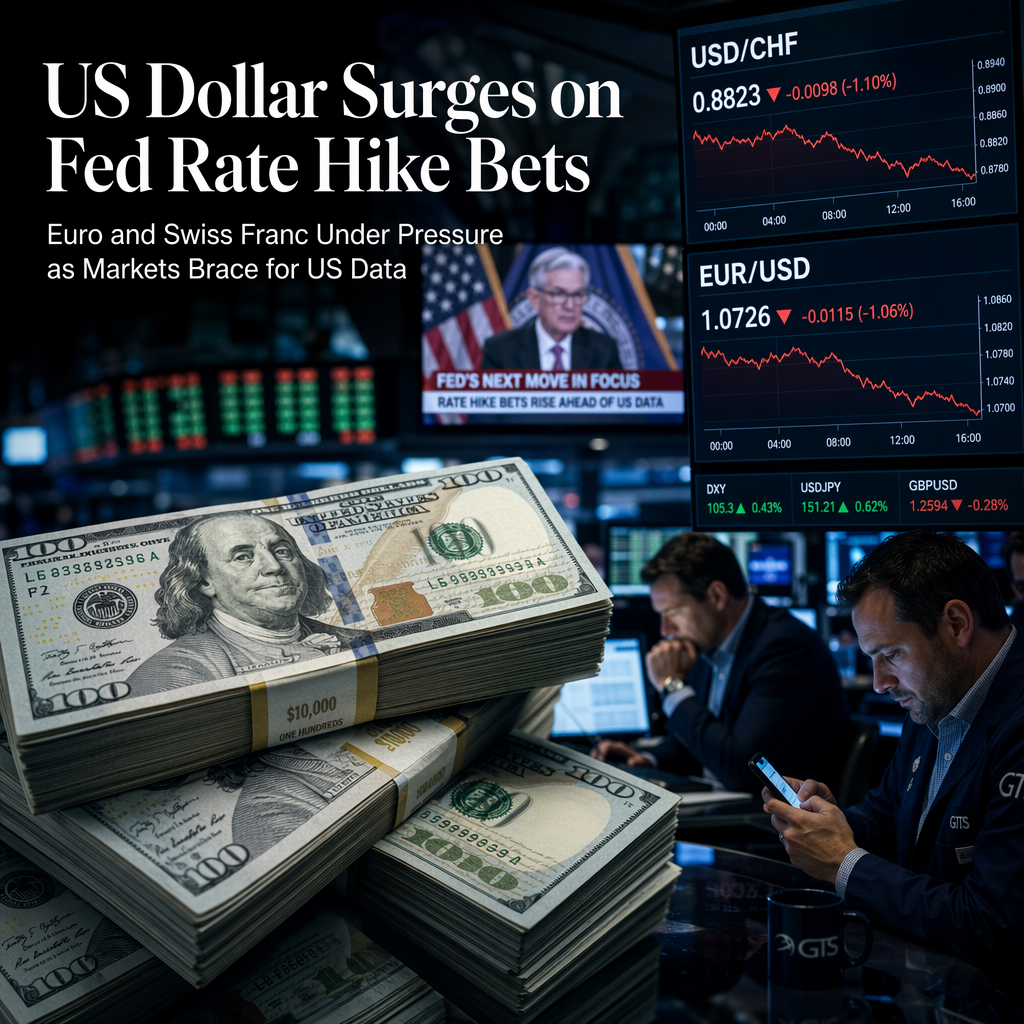
The US Dollar strengthened notably on Wednesday, with the US Dollar Index (DXY) trading near 101.30 in early European hours, as traders ramped up bets on a Federal Reserve interest rate hike following a hawkish shift at the June policy meeting [3]. The Fed kept its benchmark rate steady at 3.50%-3.75% but removed language hinting at future rate cuts, prompting fed funds futures to price in a nearly 69% chance of a rate hike by September, according to the CME FedWatch tool [3]. This sentiment was echoed in the USD/CHF pair, which gained ground for the second consecutive day, trading around 0.8090, as the Greenback drew strength from both safe-haven demand amid geopolitical tensions and rising expectations for Fed tightening [2].
The EUR/USD pair weakened to near 1.1410, pressured by receding European Central Bank (ECB) rate hike bets after Germany's Consumer Price Index (CPI) inflation fell to 2.3% in June, down from 2.6% in May and below market expectations of 2.5% [1]. ECB President Christine Lagarde recently stated there was no need for "forceful" action, citing falling energy prices and subdued wage pressures [1]. Technical analysis indicates a bearish tone for EUR/USD, with the pair holding below key moving averages and the 14-period RSI at 36, suggesting continued negative momentum [1].
Market participants are closely watching upcoming US economic data, including Wednesday's ADP Employment and ISM Manufacturing PMI reports, and Thursday's Nonfarm Payrolls (NFP), which is expected to show 110,000-111,000 job additions in June and an unemployment rate holding at 4.3% [1][3]. Analysts note that three consecutive months of stronger-than-expected NFP gains have supported the Fed's hawkish stance, and a robust June report could further bolster the Dollar [3]. Conversely, any signs of labor market weakness could prompt a dovish reassessment [3]. Ray Attrill, head of FX strategy at NAB, commented that the labor market's resilience gives the Fed no signal to consider rate cuts [3].
In Switzerland, the KOF Economic Barometer rose to 101.2 in June from 98.6 in May, beating expectations and signaling a stronger domestic economy, which may reduce pressure on the Swiss National Bank to cut rates [2]. However, the Swiss Franc declined as the USD/CHF pair advanced, reflecting the overriding influence of US Dollar strength and global risk sentiment [2].
CONCLUSION
The US Dollar's rally, driven by heightened Fed rate hike expectations and resilient US labor market data, has weighed on both the Euro and Swiss Franc. With key US employment reports ahead, market participants are bracing for further volatility, as the data will likely dictate the next major move for the Dollar and its major currency pairs.