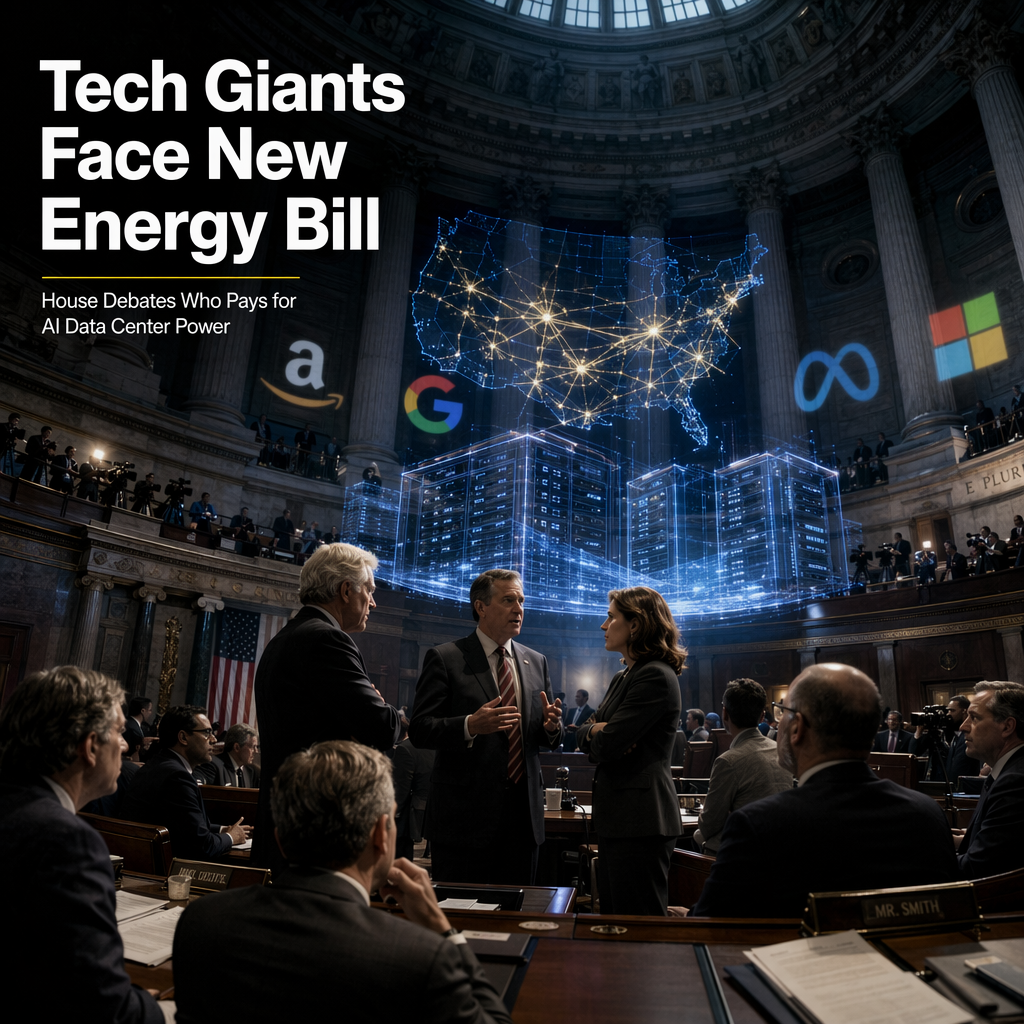
The US House of Representatives is set to consider the Ratepayer Protection Act, a bill that would require tech companies to pay for the energy costs and grid upgrades associated with artificial intelligence data centers. The House Energy and Commerce Committee's energy subpanel is scheduled to debate and vote on the bill, which aims to address growing voter dissatisfaction over rising utility costs attributed to the expansion of data centers across the country [1].
The Ratepayer Protection Act would mandate state utilities to consider establishing a 'large load standard,' compelling data center builders to finance necessary upgrades to the power grid. This legislation would codify elements of the White House's 'Ratepayer Protection Pledge' and marks one of Congress's first efforts to shift the financial burden of data centers' massive electricity demand from consumers to tech companies [1].
Major tech firms such as Amazon, Google, Meta, Microsoft, and SpaceX's xAI are identified as leading builders and operators of data centers. The bill is sponsored by Representatives Gabe Evans (R-Colo.) and Kathy Castor (D-Fla.), who emphasized the importance of protecting families, farmers, and small businesses from increased energy costs. House Energy and Commerce Chair Brett Guthrie (R-Ky.) described the bill as a bipartisan effort to ensure that grid upgrade costs are allocated according to demand, rather than being passed on to ratepayers [1].
The legislation comes as SoftBank Group Corp. pursues a $500 billion data center-focused infrastructure project in Ohio, highlighting the scale of investment and energy demand in the sector. The bill's consideration occurs just months before the midterm elections, amid heightened public scrutiny of utility costs and the political control of Washington [1].
CONCLUSION
The Ratepayer Protection Act represents a significant legislative move to shift the financial responsibility for AI data center energy costs from consumers to tech companies. With bipartisan support and involvement from major industry players, the bill could reshape how data center-related grid upgrades are funded. The outcome of the House debate may have notable implications for both the technology and energy sectors.