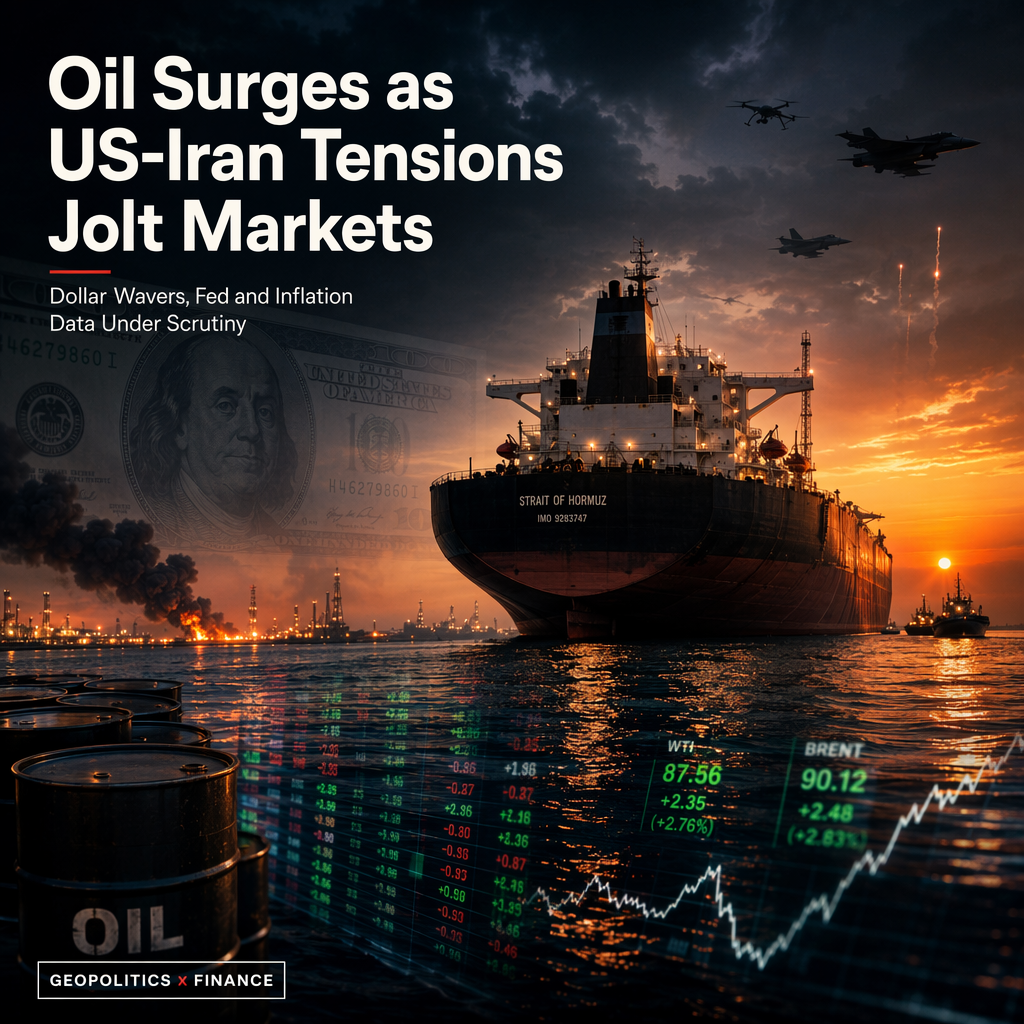
Renewed military tensions between the United States and Iran have led to a modest strengthening of the US Dollar (USD) and a surge in oil prices, with Brent crude rising back to $80 and West Texas Intermediate (WTI) crude up more than 3% to around $74 per barrel on Monday [1][2][3]. The escalation included missile and drone attacks exchanged over the weekend, with Washington striking targets in southern Iran and Tehran targeting US military facilities across the Gulf. Iran also claimed to have closed the Strait of Hormuz again, a critical channel for global oil supply [3].
The market response has been significant, with the US Dollar initially gaining but then giving back its earlier advances. The US Dollar Index (DXY) slipped below 101.00 after touching an intraday high of 101.22, while the Euro climbed above 1.1400, trading around 1.1424 after recovering from an intraday low of 1.1384 [3]. Despite the hostilities, markets perceive little chance of a full-blown war, and diplomatic efforts are ongoing, which has limited the upside for the Dollar. However, energy-driven inflation concerns have resurfaced, and traders are increasingly pricing in a Federal Reserve (Fed) interest rate hike by year-end, as well as another rate increase from the European Central Bank (ECB) [1][3].
Analysts highlight that the renewed US-Iran tensions and the resulting oil price surge are rebuilding a geopolitical risk premium in markets. MUFG’s Lee Hardman notes that higher oil prices could reinforce upside US inflation risks just as the Fed considers further rate hikes, with the upcoming June Consumer Price Index (CPI) and Fed Chair Warsh’s semi-annual testimony seen as key for Dollar direction [1]. BNY’s Geoff Yu emphasizes that the Strait of Hormuz is now the key macro channel, with sustained oil pressure likely to complicate central bank responses by combining sticky inflation, weaker consumption, and reduced policy flexibility in the coming months [2].
The US Dollar Index has been confined between 100.5 and 102 for three weeks, as traders await clarity on the Fed’s next move. The market is focused on Fed Chairman Kevin Warsh’s congressional hearings and the June US CPI data, with headline inflation expected to decline by 0.1% month-on-month in June, contrasting with May’s 0.5% rise, due to the plunge in oil prices back to pre-war levels. However, core inflation is expected to remain sticky at 0.2% month-on-month (2.9% year-on-year) [4].
In the currency markets, USD/JPY is consolidating near resistance at 162.80, with short-term moves influenced by rising Japanese Government Bond (JGB) yields, oil prices, and GPIF-related headlines. The pair remains in a narrow range, with key support at 160.40 and upside projections towards 163.70/164.40 if resistance breaks [5]. ING analysts suggest that with energy prices rising and no signs of an imminent slowdown in US activity, Fed tightening prospects remain alive, supporting the Dollar, particularly against low-yielding energy importers such as the Euro and the Japanese Yen [3].
CONCLUSION
Renewed US-Iran tensions and the resulting oil price surge have injected fresh volatility into currency and energy markets, with the US Dollar initially strengthening before paring gains. Market participants are closely watching upcoming US CPI data and Fed Chair Warsh’s testimony for further direction, as inflation risks and central bank policy responses remain in focus. The situation remains fluid, with geopolitical developments and energy prices likely to drive market sentiment in the near term.