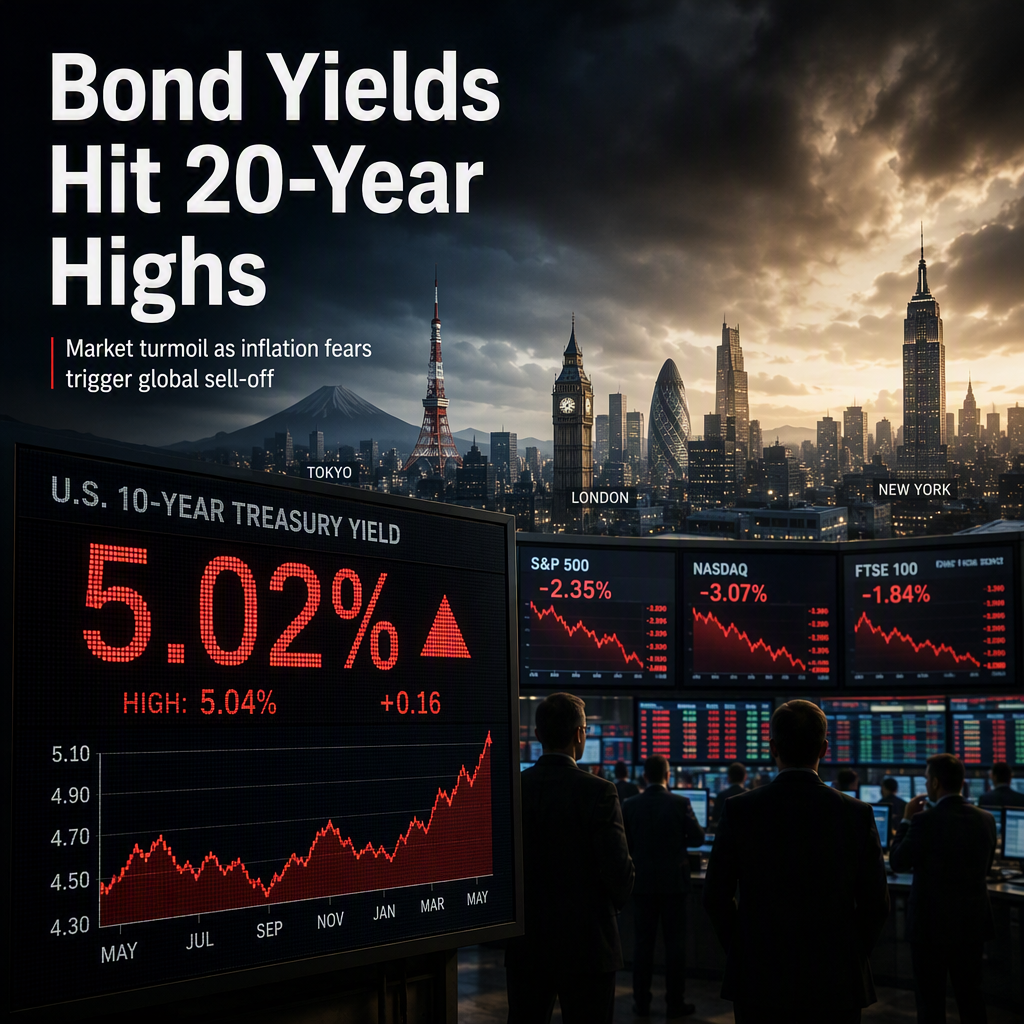
On September 15, 2026, global bond yields surged sharply, driven by persistent inflation fears and rising oil prices, as well as increased government spending in major economies [1][2]. The yield on the 10-year U.S. Treasury broke above the 5% mark, reaching 5.029% by 5 a.m. ET, its highest level in 19 years [1][2]. Yields on the 20-year and 30-year U.S. Treasurys also climbed, last seen at 5.434% and 5.391%, respectively [2]. Japanese government bond yields reached their highest point in 30 years, with the Bank of Japan expected to raise its policy rate to 1.25% next week in response to mounting inflationary pressure [1].
The surge in yields has prompted expectations that the Federal Reserve will lift rates during its two-day September meeting, which begins Tuesday [1][2]. Market participants are closely monitoring policy statements from both the Federal Reserve and the Bank of Japan for clues on future rate hikes [1]. Technical analysis indicates the 10-year U.S. Treasury yield has broken above key resistance at 4.75%, now targeting 5% as the next psychological level, with chart patterns suggesting further upside if inflation data continues to surprise [1].
The rise in bond yields has had immediate market implications, with stocks selling off in U.S. pre-market trading and slipping in European and Asian markets [2]. Barclays strategists noted that higher rates have already pressured valuations and are increasingly putting equity portfolios at risk, stating, "the approaching 5% threshold in 10Y yields marks a historically important inflection point, beyond which rates have typically become a more persistent headwind for equities" [2]. Goldman Sachs Research Chief U.S. Equity Strategist David Kostin highlighted that equities tend to struggle when yields rise due to fiscal concerns rather than expectations for economic growth [2].
The global bond sell-off reflects growing concerns that inflation may prove more stubborn than previously anticipated, forcing central banks to maintain a hawkish stance [1]. Investors are adjusting portfolios in anticipation of tighter monetary policy and higher borrowing costs, with volatility increasing across global bond markets [1][2]. Barclays strategists warned that with inflation risks lingering and yields moving higher, the cushion provided by earnings growth may become increasingly difficult to maintain [2].
CONCLUSION
Global bond yields have surged to multi-decade highs, driven by persistent inflation fears and fiscal concerns, prompting expectations of further rate hikes by central banks. The sharp rise in yields has triggered a sell-off in equities and increased volatility across financial markets. Analysts warn that the 5% threshold in 10-year Treasury yields marks a critical inflection point, potentially posing a persistent headwind for stocks if inflation remains elevated.