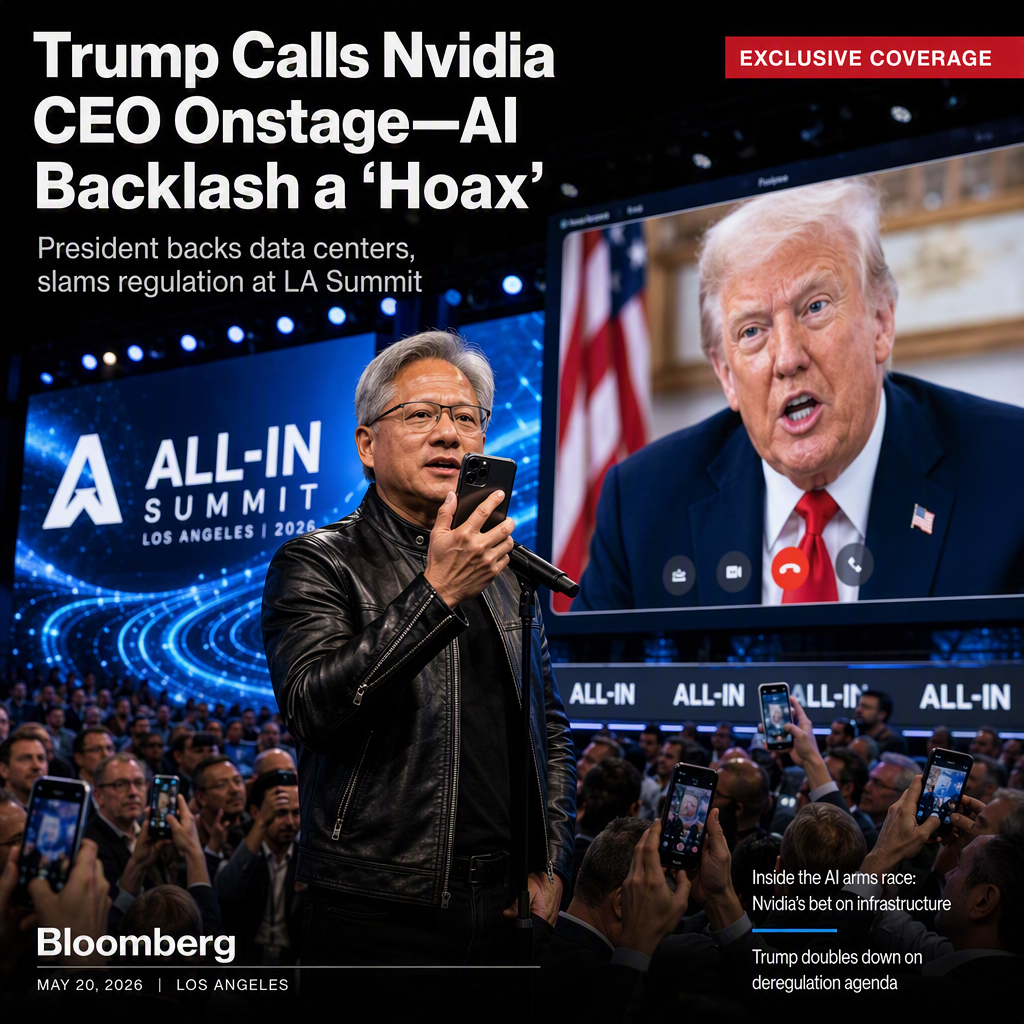
At the All-In Summit in Los Angeles on September 14, 2026, President Donald Trump made an unexpected phone call to Nvidia CEO Jensen Huang while Huang was on stage, an event confirmed by attendee social media posts and videos. Huang put Trump on speakerphone, allowing the audience to hear the president's remarks directly [1].
During the call, Trump addressed the ongoing backlash against artificial intelligence (AI) and data center construction, labeling the opposition as a 'hoax.' He stated, 'The data centers are great, and they make people wealthy, and they make states wealthy,' emphasizing the economic benefits of AI infrastructure [1]. Trump further described data centers as the 'oil of the next 20, 25 years,' highlighting their perceived strategic importance to the U.S. economy [1].
Trump's comments come amid heightened debate in Washington about the rapid development of AI technologies by companies such as Anthropic and OpenAI. Over the weekend, Anthropic CEO Dario Amodei published an essay advocating for a slowdown in AI model development, a position supported by OpenAI CEO Sam Altman and SpaceX's Elon Musk. Trump, however, used his social media platform to criticize these calls for caution, referring to those concerned about AI and data centers as 'Revolutionaries for a Bad and Evil Cause' and dismissing the need for additional AI regulation as a 'hoax' and 'a scam.' He argued that such opposition arises because the U.S. is leading the world in data center construction [1].
Trump also suggested that resistance to data center expansion could be influenced by foreign interests, specifically mentioning China, and pledged, 'We're not going to let that happen.' He expressed strong support for Huang and Nvidia, stating, 'I'm with you all the way.' The event underscores the close relationship between Trump and Huang and the central role of AI and data centers in current U.S. economic policy discussions [1].
CONCLUSION
President Trump's public endorsement of Nvidia and AI data center expansion at the All-In Summit signals strong political support for the sector, despite growing calls for regulation. His remarks are likely to be viewed positively by investors and industry stakeholders, reinforcing the strategic importance of AI infrastructure to the U.S. economy.