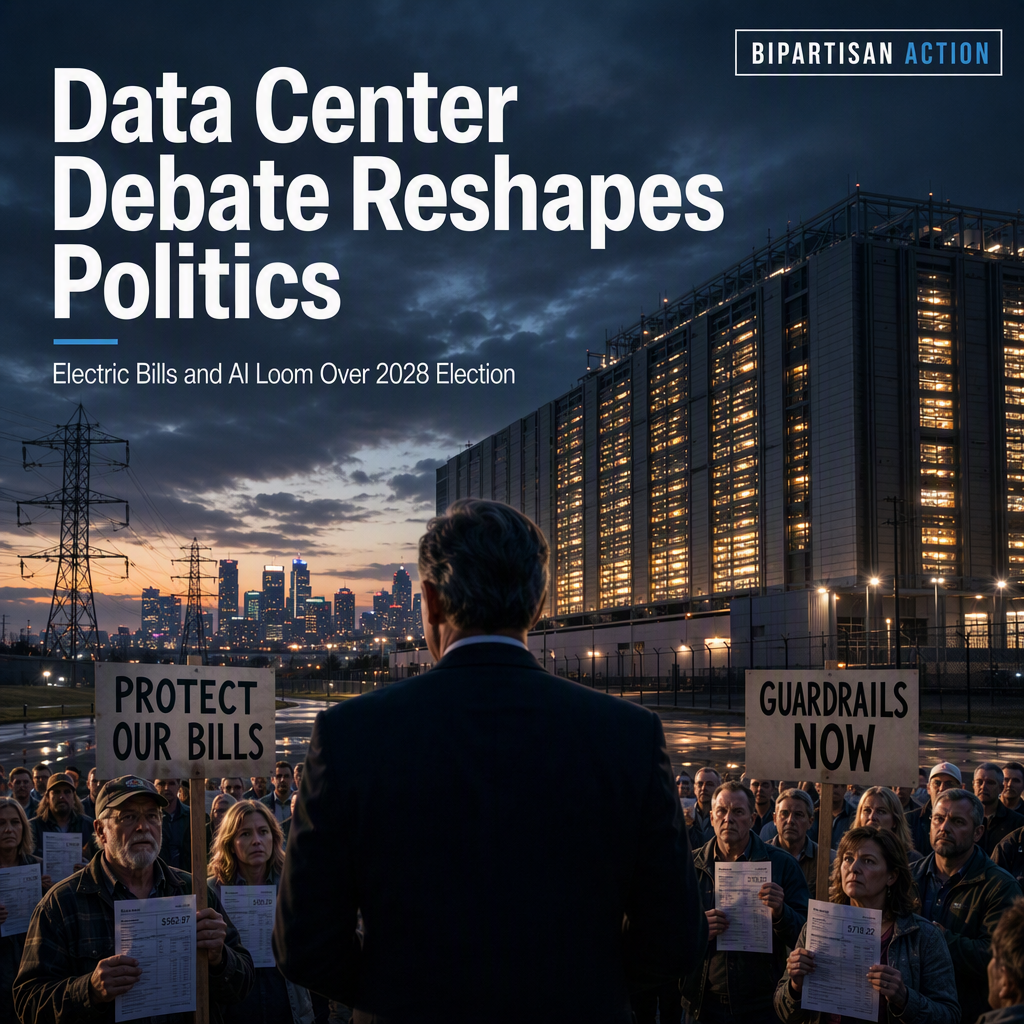
A growing debate over the construction of data centers in the United States is influencing both state and national politics, with significant implications for the country's AI competitiveness and energy costs [1]. The issue has become so prominent that it is expected to play a role in the 2028 presidential election, as illustrated by a hypothetical debate scenario where candidates are questioned about their past decisions to restrict data center construction and the resulting economic consequences, such as job losses in regions like Youngstown, Ohio [1].
Public concern over rising electric bills is a driving force behind the political shift. At a Public Service Commission hearing in Hancock County, Kentucky, resident Gary Elder expressed fears that a proposed 500-megawatt data center could push his electric bill toward $1,000 or more, reflecting the sentiment of seven in ten Americans who oppose having a data center in their community [1]. This widespread opposition has prompted swift action from politicians across party lines. By August, Pennsylvania's Democratic Governor Josh Shapiro signed what he described as the 'strictest guardrails in the nation' for data centers, while Texas Republican Governor Greg Abbott froze new grid connections pending a statewide audit [1].
Other states have taken similar or even more stringent measures. New York's Democratic Governor Kathy Hochul paused environmental permits for data centers for a year, and Florida's Republican Governor Ron DeSantis ensured that local governments retain the authority to reject data center projects [1]. These actions demonstrate a bipartisan convergence on the issue, with both Republicans and Democrats responding to voter anxiety over energy costs and local impacts [1].
In contrast, former President Donald Trump has positioned himself as a strong advocate for data center expansion, criticizing Abbott's freeze as a 'mistake.' Senate Republicans have privately warned that the controversy could affect their chances in Ohio's Senate race, where Trump-endorsed Senator Jon Husted is trailing and has become associated with the data center debate [1]. The issue is also central in Ohio's gubernatorial race, with both Republican Vivek Ramaswamy and Democrat Amy Acton calling for moratoriums on data center construction [1].
The ongoing debate highlights the tension between the need to manage rising energy costs and the desire to maintain America's leadership in AI and technology infrastructure. Politicians are weighing the risks of being seen as responsible for higher electric bills against the potential long-term consequences of ceding technological advantage [1].
CONCLUSION
The controversy over data center construction is reshaping political strategies at both the state and national levels, with bipartisan action to restrict or regulate new projects in response to public concern over energy costs. This debate is expected to remain a key issue through the 2028 presidential election, with significant implications for America's AI competitiveness and energy policy.