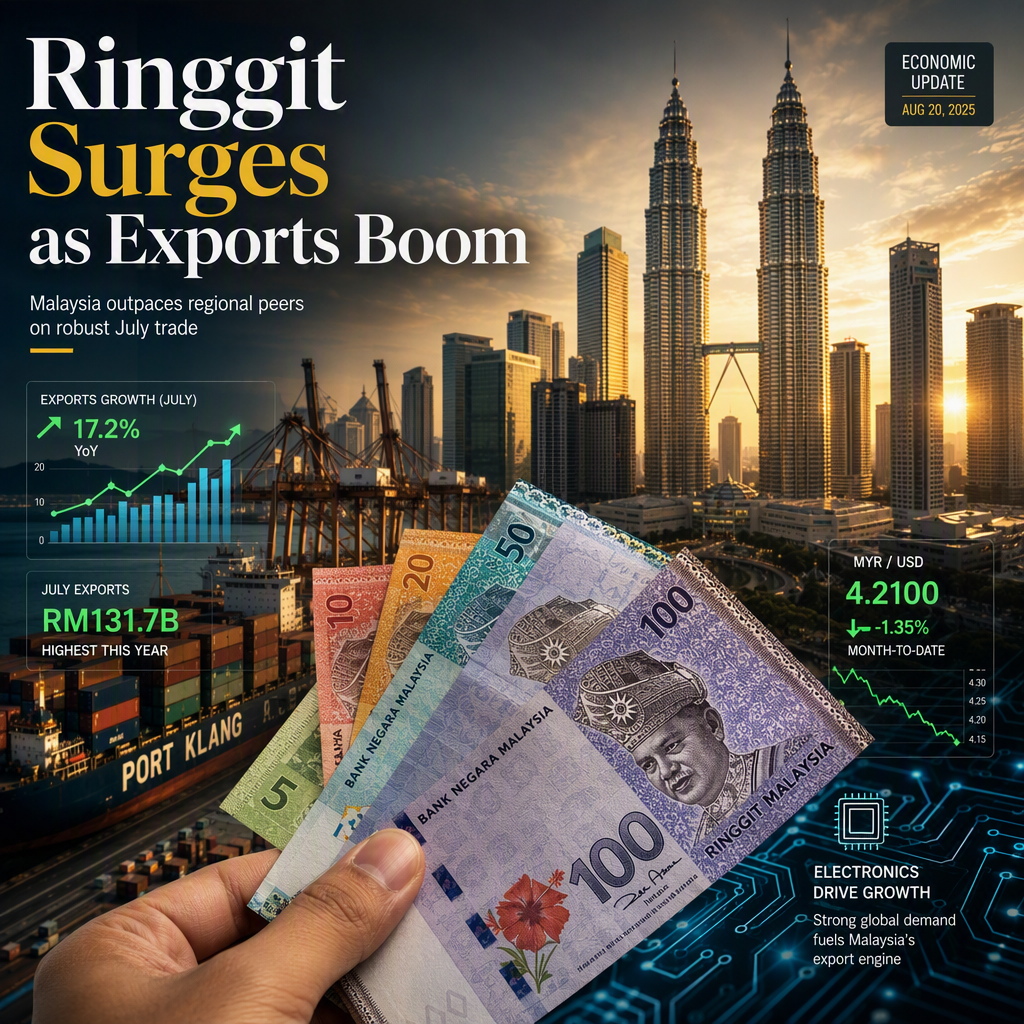
Malaysia's July exports rose by 38.0% year-on-year, surpassing the Bloomberg consensus of 35.0% and marking the fourth consecutive month of double-digit growth, according to Commerzbank’s Moses Lim [1]. This robust performance was driven by strong external demand, particularly in electronics and machinery, with AI-related infrastructure demand from hyperscalers cited as a key driver [1]. Exports to the US surged by 79.8% in July, while shipments to China increased by 30.2%, underscoring continued support from major trading partners [1].
Imports also exceeded expectations, rising 36.4% year-on-year (Bloomberg consensus: 31.8%), led by a 24.0% increase in capital goods imports, which suggests healthy investment momentum [1]. The trade surplus widened more than anticipated to MYR22.5bn (Bloomberg consensus: MYR22.9bn), up from MYR15.8bn previously [1].
In the foreign exchange market, the USD/MYR pair fell 0.3% to 4.05, marking its fourth consecutive session of decline and approaching its lowest level since early June due to a weaker US dollar [1]. Year-to-date, the Malaysian Ringgit is up 0.4% against the USD, outperforming the average for Asian ex-Japan currencies, which are down 1.5% [1].
Looking forward, Commerzbank notes that export growth could face challenges from high base effects, geopolitical uncertainties, and potential weather-related disruptions from El Niño. However, resilient external demand may help offset some downside risks. While Malaysia faces a 10% US tariff following the Section 301 forced labour investigation, approximately two-thirds of its exports to the US remain exempt [1].
CONCLUSION
Malaysia's strong July trade data has bolstered the Ringgit, which is outperforming regional peers amid robust external demand and investment momentum. While some risks remain, the outlook is supported by continued demand for electronics and machinery, especially from the US and China.