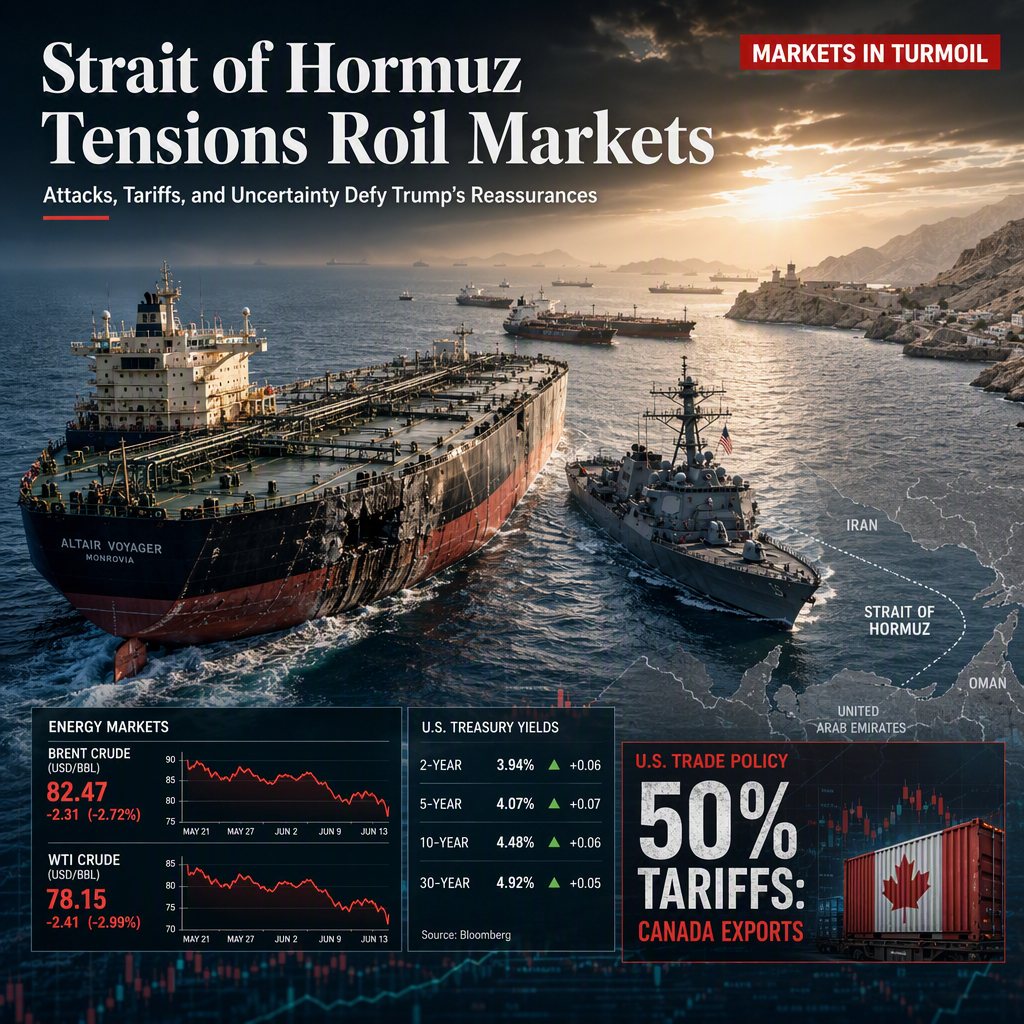
U.S. President Donald Trump asserted that the Strait of Hormuz is 'open and operating,' but shipping data and market reactions suggest otherwise. Despite Trump's statement on Tuesday, shipping traffic through the critical energy waterway has dropped to a three-month low, with a five-day average of just 10 vessel crossings—the lowest since May—according to commodity analytics firm Kpler. This slowdown comes amid ongoing attacks on vessels, including a recent incident where a cargo ship was attacked while exiting the strait via Omani waters, resulting in one crew member's death. The U.S. military has been assisting vessels on the 'southern route,' but attacks persist, heightening concerns over the safety of this vital shipping corridor [1].
President Trump has ruled out any new negotiations with Iran following the expiration of a temporary ceasefire, stating, 'There are no talks or conversations going on, or scheduled, with the Islamic Republic of Iran.' The lack of diplomatic progress has increased uncertainty about the strait's status and contributed to market unease [1].
Financial markets have responded with skepticism to Trump's assurances. Oil prices remain elevated, with Brent crude holding above $91 per barrel and U.S. West Texas Intermediate futures rising 0.52% to $85.38 in early Asia trading. U.S. Treasury yields have surged to multi-decade highs as hopes for an end to Middle East hostilities fade. The U.S. fiscal deficit reached $432.3 billion in July, the highest monthly total since March 2021, pushing the year-to-date shortfall to nearly $1.8 trillion. Interest payments on the nearly $40 trillion national debt have cost the government about $1.2 trillion this year. Global bond yields have also climbed, with Germany's 10-year bund yield hitting a 15-year high and Japan's 10-year bond yield surpassing the 30-year high seen earlier in 2026 [1].
Trade tensions are escalating as Trump's 50% tariffs on approximately $20 billion of Canadian imports are set to take effect within hours unless a last-minute agreement is reached. The tariffs target products such as alcohol, dairy goods, cement, and hockey sticks. Despite discussions between Trump and Canadian Prime Minister Mark Carney, no resolution has been achieved, and the tariffs are poised to be implemented [1].
Additionally, the latest U.S. National Defense Strategy for 2026 omits any explicit mention of extended deterrence, causing allies to question the reliability of the U.S. nuclear umbrella—a shift that could have long-term geopolitical implications [1].
CONCLUSION
Despite President Trump's assurances, markets remain unconvinced about the security and openness of the Strait of Hormuz, as evidenced by reduced shipping traffic and elevated oil prices. Rising U.S. Treasury yields, a ballooning fiscal deficit, and the imminent imposition of steep tariffs on Canadian imports have further unsettled global markets. The combination of geopolitical tensions and economic uncertainty is driving significant market volatility.