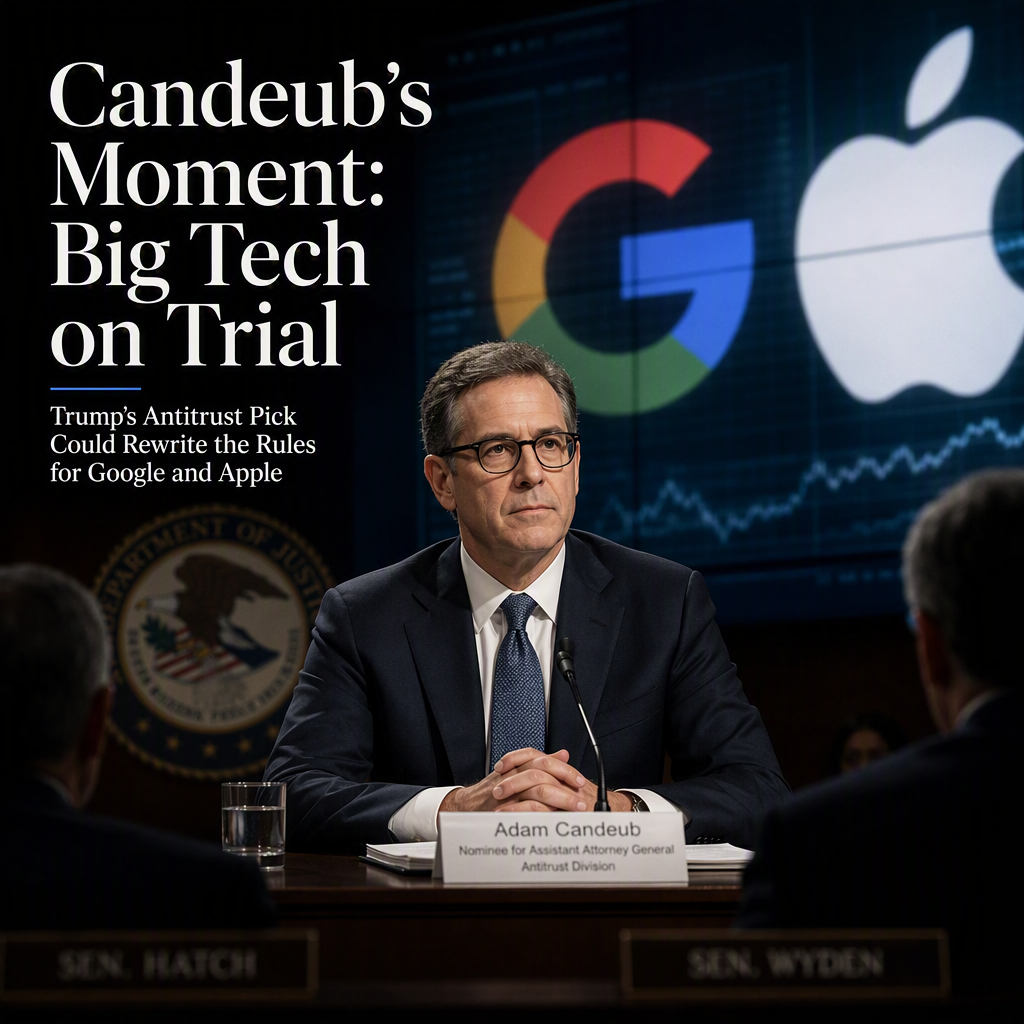
President Donald Trump's nominee to lead the Justice Department's Antitrust Division, Adam Candeub, testified before the Senate in a confirmation hearing that could significantly influence the government's ongoing antitrust actions against major technology companies, specifically Google and Apple [1]. If confirmed, Candeub would oversee landmark lawsuits targeting Google's dominance in online search and Apple's control over the App Store and its rules for developers, with the potential to determine the future direction and aggressiveness of federal antitrust enforcement against Big Tech [1].
Candeub is recognized as a prominent conservative critic of large technology platforms, arguing that their market power has been underestimated by regulators and poses risks to competition, free speech, and public discourse [1]. In his March 2023 congressional testimony, Candeub stated, "Big Tech’s market power undermines our Nation’s culture of vibrant democratic deliberation," and referenced the 'Twitter files' as evidence of online platforms limiting participation in national political discussions [1].
He has advocated for reforms to Section 230, the federal law shielding online platforms from liability for user content, and previously worked to narrow these protections during Trump's first administration [1]. In the Heritage Foundation's Project 2025 policy blueprint, Candeub argued that antitrust enforcement has failed to address the influence of major technology platforms over competition and information flow, noting that despite their size, these companies have largely avoided significant antitrust liability or prosecution [1].
Candeub's nomination has received support from former Justice Department officials, indicating a potential shift toward more aggressive antitrust scrutiny of Big Tech if he is confirmed [1].
CONCLUSION
Adam Candeub's confirmation as head of the Justice Department's Antitrust Division could mark a pivotal shift in the government's approach to antitrust enforcement against major technology companies like Google and Apple. His critical stance on Big Tech and advocacy for narrowing Section 230 protections signal the possibility of more rigorous regulatory action, with significant implications for the tech industry and market competition.