
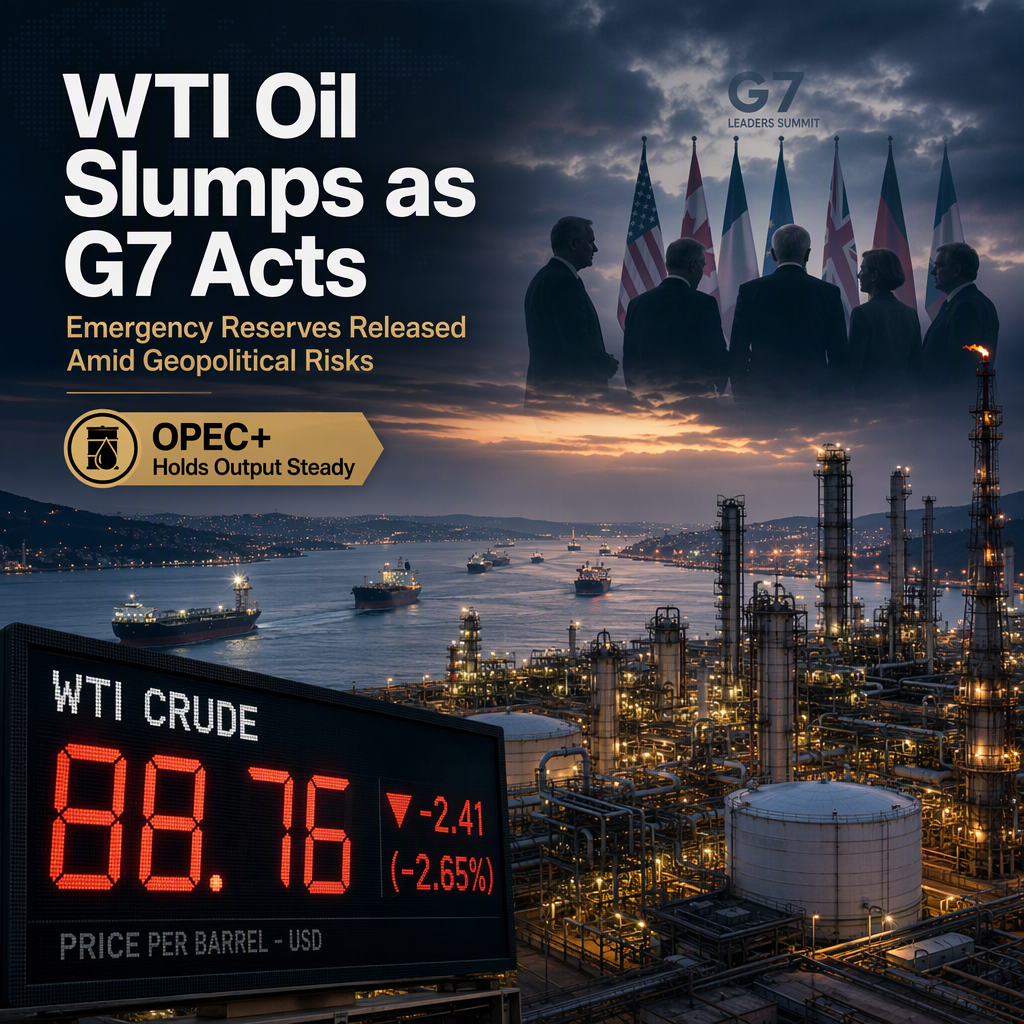
West Texas Intermediate (WTI) crude oil prices extended their decline for a second consecutive day, trading around $89.30 during Asian hours on Monday, following a series of significant market developments [1]. The drop in oil prices was primarily triggered by the G7 nations' agreement to release 100 million barrels of crude and diesel from emergency reserves. This move was accompanied by a pledge from the G7 to avoid energy export restrictions, a decision made under pressure from US President Donald Trump [1].
In addition to the G7 action, the Organization of Petroleum Exporting Countries and its allies (OPEC+) decided to maintain steady production targets for November, aligning with market expectations that any further changes to output policy would be postponed until the following year [1]. Despite this, key producers such as Saudi Arabia, Russia, Iraq, Kuwait, Algeria, Kazakhstan, and Oman are operating well below their designated quotas, with overall exports running at just 60% to 80% of normal volumes due to ongoing export disruptions linked to the conflict involving the US, Israel, and Iran [1].
Regional crude exports had briefly surged above pre-war levels in late September, peaking at 22.5 million barrels per day compared to a pre-war average of 18 million barrels per day recorded between March 2025 and February [1]. However, ongoing geopolitical instability continues to cast a shadow over the market. Tensions escalated as Saudi-backed forces in Yemen launched a major offensive to reclaim territory from Houthi forces, following the Iran-backed group's capture of the strategic Bab el-Mandeb strait—a critical maritime passage for Saudi oil shipments [1].
Analysts at Rabobank observed that Brent crude prices also retreated last week as improved flows through the Strait of Hormuz and the partial restoration of Saudi Arabia’s East-West pipeline helped ease supply concerns, signaling a tentative normalization in physical market conditions [1]. Nevertheless, they cautioned that the deployment of another aircraft carrier to the Middle East could disrupt the recent recovery, emphasizing that geopolitical risks remain a significant factor that could reverse the current pullback in prices [1].
CONCLUSION
The release of emergency reserves by the G7 and OPEC+'s decision to hold production steady have contributed to a notable decline in WTI oil prices. While some supply concerns have eased, ongoing geopolitical tensions in the Middle East continue to pose risks to market stability. Analysts warn that further escalation could quickly reverse the recent price declines.