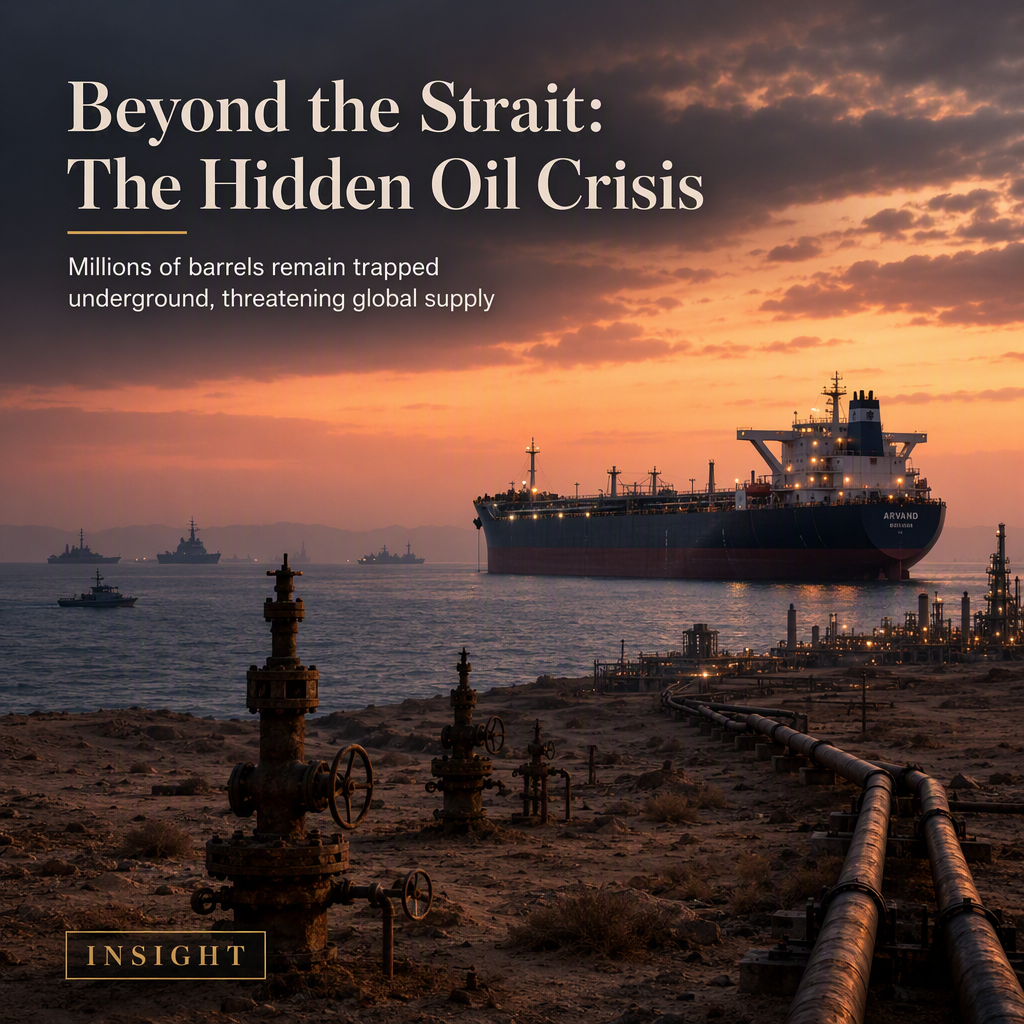
The ongoing crisis in the Strait of Hormuz has drawn global attention to the risks facing oil tankers, but petroleum geologist and energy consultant Art Berman warns that a more significant and enduring threat lies in the millions of barrels of Persian Gulf oil production currently shut in underground [1]. Berman stated that 8 million barrels of Persian Gulf production are shut in, contributing to a global oil production decline of about 10 million barrels per day [1]. This estimate aligns with the International Energy Agency's (IEA) August 12, 2026 Oil Market Report, which noted that Gulf oil production rose by 2.5 million barrels per day in July to 23.9 million barrels per day, but remains 8.3 million barrels per day below pre-war levels. The IEA also reported that global oil supply is 6.3 million barrels per day below year-earlier levels [1].
The U.S. Energy Information Administration (EIA) offers a slightly different perspective, estimating average production shut-ins at 5.5 million barrels per day in July. The EIA also warned that ongoing constraints on Hormuz transit have led to an increased forecast for shut-in production in August. While the EIA expects production and trade patterns to generally return to pre-conflict conditions by early 2027, it cautions that some Gulf producers may not regain their previous output levels within its forecast period [1].
Berman emphasized that the challenge is not just the safe passage of oil through the Strait (the midstream problem), but the more complex issue of restoring production from wells that have been shut in (the upstream problem). Restarting these wells is a complicated, high-risk, and potentially long-term process, with uncertain outcomes. Berman estimated that about 80% of affected wells could return to near previous production levels within weeks or months, but many others may require additional engineering work or may never fully recover [1].
This situation suggests that even if political agreements resolve the immediate conflict and reopen the Strait of Hormuz, the world could still face a prolonged period of reduced oil supply due to the technical challenges of restoring shut-in wells [1].
CONCLUSION
The Strait of Hormuz crisis has exposed a deeper, long-term threat to global oil supply, with millions of barrels of Persian Gulf production shut in and uncertain prospects for full recovery. Even if transit through the Strait resumes, technical challenges in restarting wells could keep global oil production below pre-war levels for an extended period, posing significant risks to energy markets.