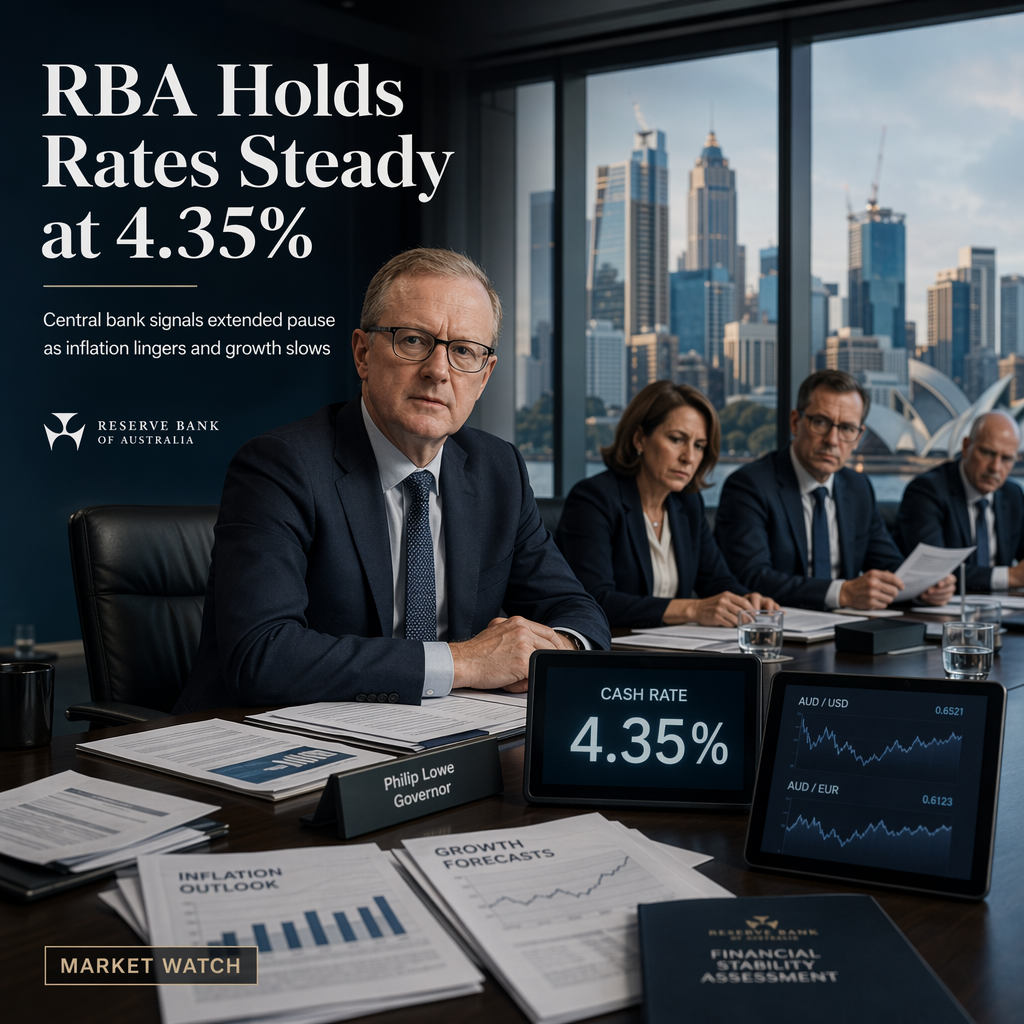
The Reserve Bank of Australia (RBA) decided to keep its policy rate steady at 4.35% following three consecutive 25 basis point hikes earlier this year, maintaining a tightening bias and signaling readiness to hike again if necessary [1][2]. Policymakers cited persistent inflation above target levels as a key concern, but also acknowledged that economic growth is slowing and unemployment is rising, which points to a likely extended pause in the rate hiking cycle [1][2].
According to OCBC’s Christopher Wong, the RBA’s decision reflects a 'holding pattern,' with the central bank resisting an outright end to the hiking cycle while recognizing the need to assess the lagged effects of previous tightening measures [1]. UOB Global Economics & Markets Research echoed this view, noting that the RBA paused in June to evaluate the impact of earlier hikes amid signs of economic softening and weaker household demand [2]. UOB’s base case is for the RBA to extend its pause over the coming meetings, expecting restrictive financial conditions and rising unemployment to gradually dampen inflationary pressures [2].
Market reaction was muted, with AUD/USD closing largely unchanged at 0.7067, down just 0.07% after the announcement [2]. Analysts highlighted that while the RBA retains a tightening bias, the risks to the outlook remain balanced, with uncertainty stemming from global energy risks and potential stagflationary outcomes [2].
In the context of G10 currencies, the Australian dollar is expected to find some support from its status as a top yielder, even as the RBA nears the end of its tightening cycle [1]. However, the AUD/NZD pair appears 'toppish' as the Reserve Bank of New Zealand maintains a more hawkish stance [1].
CONCLUSION
The RBA’s decision to hold rates at 4.35% while maintaining a tightening bias signals a cautious approach amid persistent inflation and a softening economy. Market reaction was limited, with analysts expecting an extended pause in rate hikes as restrictive conditions weigh on growth and inflation. The Australian dollar remains supported by its yield advantage, but further policy moves will depend on evolving economic data.