
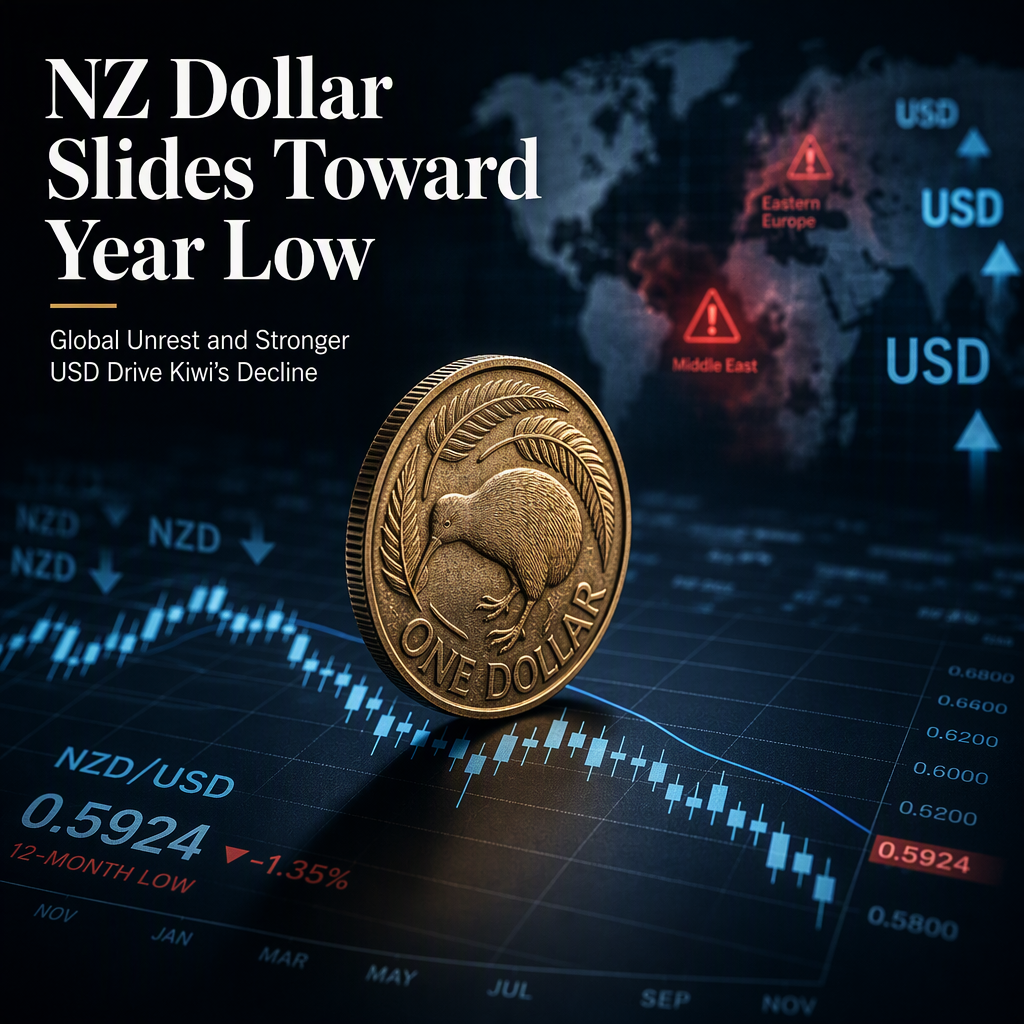
The New Zealand Dollar (NZD) continued its downward trajectory on Monday, with the NZD/USD pair trading around 0.5582, marking a 0.70% decline for the day and approaching its November 2025 low at 0.5580 after six consecutive weeks of losses [1]. The currency pair is now situated near a critical support zone between 0.5580 and 0.5470, an area that has previously triggered notable rebounds since 2020, drawing increased market attention to its current behavior [1].
The persistent weakness in the NZD is attributed to renewed demand for the US Dollar (USD) as global financial markets adopt a risk-averse stance. This shift is driven by turmoil in global bond markets and heightened geopolitical risks, including military operations in Yemen, threats to the Strait of Hormuz by Iranian officials, and ongoing Russian strikes on Ukraine, all of which have bolstered the appeal of safe-haven assets like the USD [1]. Elevated energy prices and concerns about persistent inflation and deteriorating public finances in major economies have further intensified market caution [1].
Despite recent US inflation and employment data reducing expectations for an imminent Federal Reserve interest rate hike in October and pushing US Treasury yields lower, the possibility of another rate increase before year-end continues to support the Greenback [1]. Investors are now focused on upcoming US economic releases, particularly the ISM Services PMI, expected to ease to 55 in September from 55.4 in August, and the final S&P Global Services PMI, which recently hit a five-year high at 58.7 [1].
On the New Zealand front, expectations for further monetary tightening by the Reserve Bank of New Zealand (RBNZ) at its October 28 meeting have not been sufficient to halt the Kiwi's decline. However, if market expectations for higher interest rates strengthen, this could potentially provide some support to the NZD going forward [1].
CONCLUSION
The New Zealand Dollar is under significant pressure, nearing a one-year low against the US Dollar as global risk aversion and geopolitical tensions drive demand for safe-haven assets. While upcoming US and New Zealand economic data and central bank decisions may influence future moves, current market sentiment remains negative for the NZD.