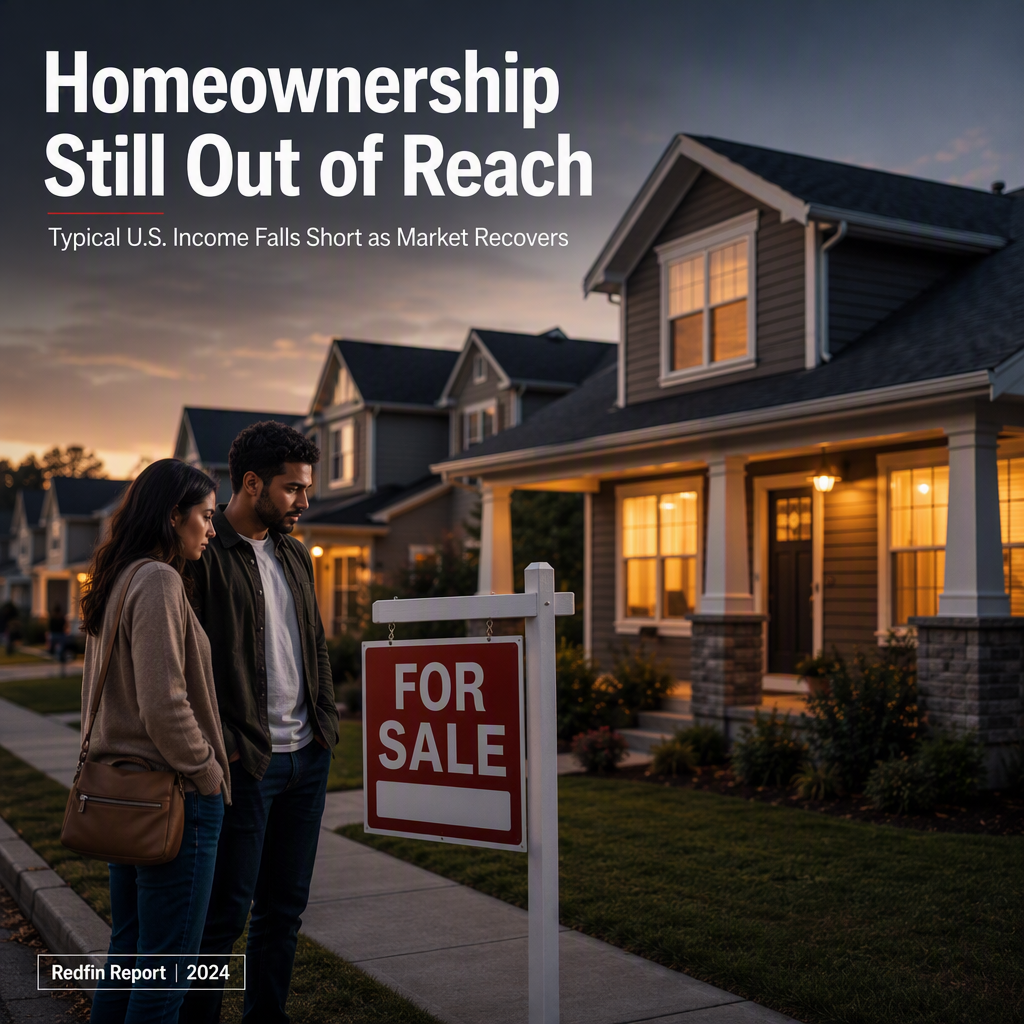
A new Redfin report highlights that the income required to afford a typical American home remains near historic highs, despite a slight decrease from last year's peak. As of June, buyers need an income of $109,796 to afford a median-priced home, which is a 0.5% decrease from the all-time high of $110,382 reached last year [1]. The gap between the typical household income and the income needed to buy a home has narrowed, with the typical household earning $87,599—still $22,197 below the required amount [1]. This gap was $26,125 a year ago and $28,834 two years ago, with Redfin attributing the improvement to household income growth outpacing housing cost increases in recent years [1].
The median home sale price increased by 2.2% in June compared to last year, while mortgage rates have slightly decreased to the mid-6% range. Median household income rose by 4% over the same period [1]. Redfin senior economist Yingqi Xu noted that while the earnings needed to buy a house have stabilized, homes remain unaffordable for the average American, with a persistent double-digit gap between typical earnings and the required income [1].
The share of affordable listings—defined as homes where the mortgage consumes no more than 30% of a buyer's income—rose from 31% last year to 34% in June. However, this is still significantly lower than pre-2022 levels, when over half of U.S. home listings were affordable to the typical American in nearly every month since 2013 [1].
Affordability improved in 24 of the 46 metro areas analyzed by Redfin. Seattle saw the largest improvement, with the income needed to afford a median-priced home dropping 7.4% to $221,831. San Jose and Portland followed, with declines of 6.5% (to $423,840) and 4.5% (to $153,844), respectively, compared to a year ago [1].
CONCLUSION
While the income needed to afford a typical U.S. home has slightly decreased and affordability has improved in some metro areas, the majority of American households still face a significant gap between their earnings and what is required to purchase a home. The market remains challenging for average buyers, with affordability only modestly improving from historic lows.