
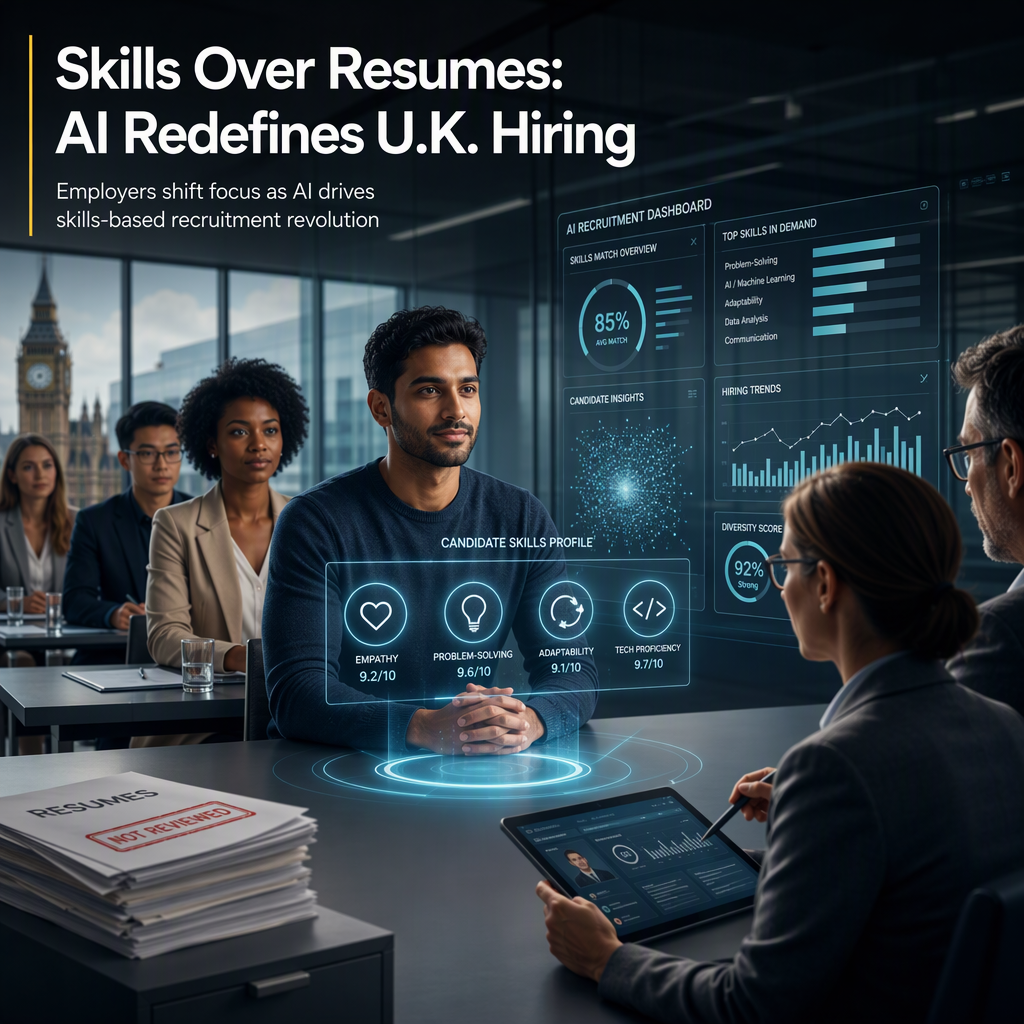
Artificial intelligence is fundamentally altering the job application process, prompting companies to reconsider their reliance on traditional resumes and cover letters. According to Barb Hyman, founder and CEO of Sapia.ai, AI enables candidates to generate limitless tailored resumes, making it increasingly difficult for employers to identify the right talent using conventional methods. Hyman describes the resume as 'broken' and emphasizes that skills, rather than employment history, will become the primary criteria for hiring decisions. She cites the example of a hairdresser potentially excelling in a contact center role due to transferable skills such as empathy and problem-solving, which may not be evident on a standard CV [1].
The competitive landscape is intensifying, with U.K. graduate employers receiving an average of 140 applications per vacancy in 2025—the highest in three decades, according to the Institute of Student Employers. This surge is attributed in part to AI tools that allow candidates to mass-produce customized applications, further complicating the selection process [1].
The shift toward skills-based hiring is gaining momentum. Research from Michael Page in 2026 indicates that approximately two-thirds of U.K. organizations have adopted skills-based recruitment practices. Nearly 60% of candidates report being more likely to apply for roles defined by skills rather than traditional qualifications or career history. This trend is compelling employers to reassess which skills are most valuable for their organizations [1].
James Broadhead, CTO of Taktile, highlights that AI has accelerated the prototyping process, enabling engineers to generate multiple prototypes in a single afternoon—a task that previously took weeks. As a result, the focus has shifted to evaluating candidates' judgment, interpersonal skills, self-reflection, and adaptability to rapidly evolving AI tools. Companies like Taktile and PMG are increasingly assessing candidates through practical exercises and by examining their ability to adapt to new AI developments [1].
CONCLUSION
The rise of AI is driving a significant transformation in hiring practices, with a clear shift toward skills-based recruitment in the U.K. This evolution is reshaping how employers evaluate talent and compelling both organizations and candidates to prioritize adaptability and relevant skills over traditional credentials.