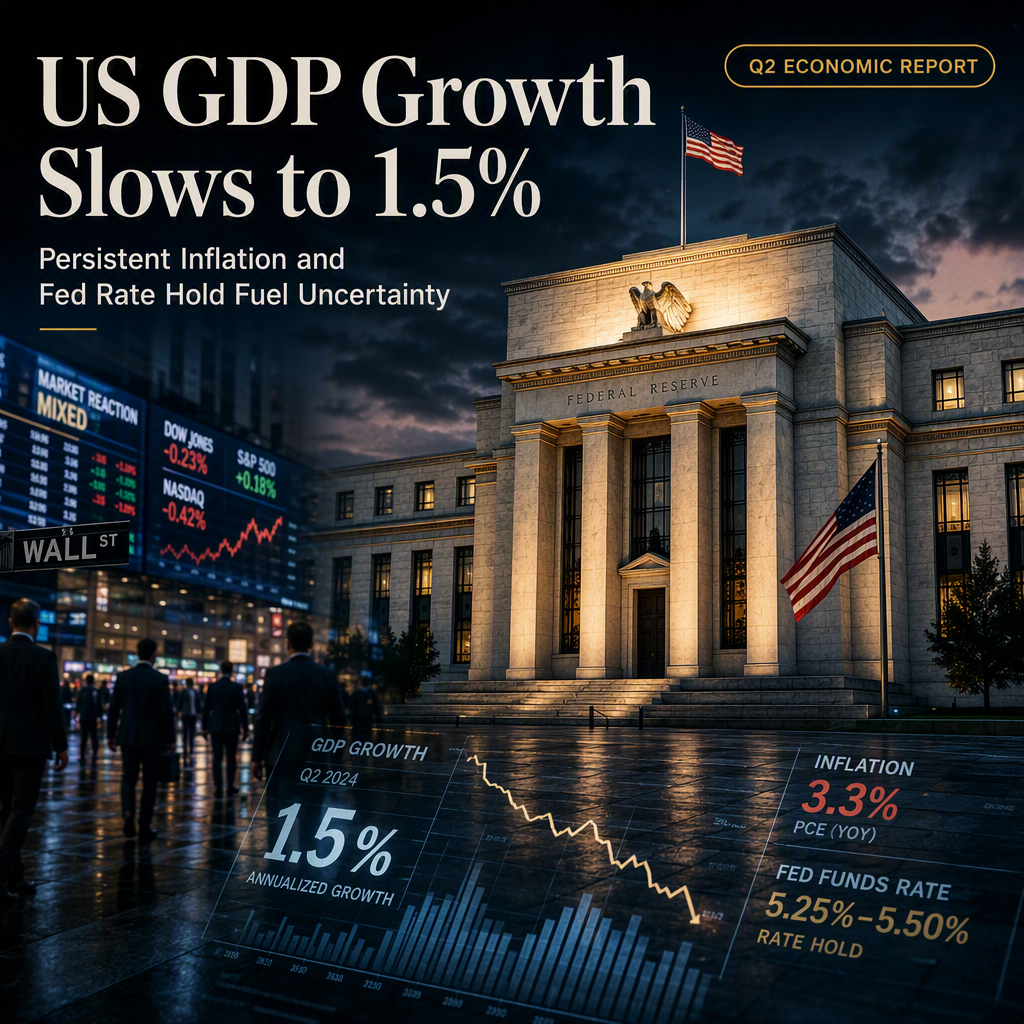
The U.S. economy experienced an unexpected slowdown in the second quarter of the year, with the Bureau of Economic Analysis reporting an annualized GDP growth rate of 1.5% for April through June, according to the Commerce Department's advance estimate [1][2]. This figure was below the 2.1% growth estimate from economists polled by LSEG [1] and the 1.8% forecast from Dow Jones, following a 2.1% increase in the first quarter [2]. The miss in GDP growth was attributed primarily to declines in federal government spending and inventories, which fell 0.3% and 0.7% respectively, while other sectors showed resilience [2]. Personal spending rose 2.1% after a modest 0.4% gain in Q1, and final sales to private domestic purchasers—a key indicator of underlying demand—posted a robust 3.9% increase [2]. Gross private domestic investment and exports both increased by 0.5%, while imports declined 1.5%, contributing positively to GDP [2].
Inflation remained elevated, with the personal consumption expenditures (PCE) price index—the Federal Reserve's primary forecasting gauge—falling 0.1% for June, resulting in an annual inflation rate of 3.7% [2]. Core PCE, which excludes food and energy, increased 0.1% monthly and stood at 3.3% annually, matching forecasts [2]. Despite the headline PCE being the official gauge for Fed policy, most officials view core inflation as a better indicator of longer-term trends [2].
The economic reports followed a divided Federal Reserve decision to keep its benchmark borrowing rate unchanged in the 3.5%-3.75% range, with a 9-3 vote among policymakers [2]. The three dissenting votes came from regional presidents concerned about persistent inflation and the lack of progress toward the Fed's price stability mandate [2]. Uncertainty surrounds the Fed's latest decision, with critics voicing concerns about its potential impact on the market [1].
Market reactions were mixed: stock market futures were positive after the report, while Treasury yields rose sharply [2]. Analysts from Horizon Portfolio Management and SlateStone Wealth discussed the implications of the Fed's rate hold, noting ongoing uncertainty and potential market impacts [1]. Revised GDP estimates are scheduled for late August, with final revisions expected at the end of September [1].
CONCLUSION
The U.S. economy's slower-than-expected growth in Q2, coupled with persistent inflation and a divided Fed decision to hold rates, has created an atmosphere of uncertainty. While underlying demand remains strong, market reactions have been mixed, and further clarity is expected with upcoming GDP revisions. Investors and policymakers will closely monitor inflation and spending trends as the year progresses.