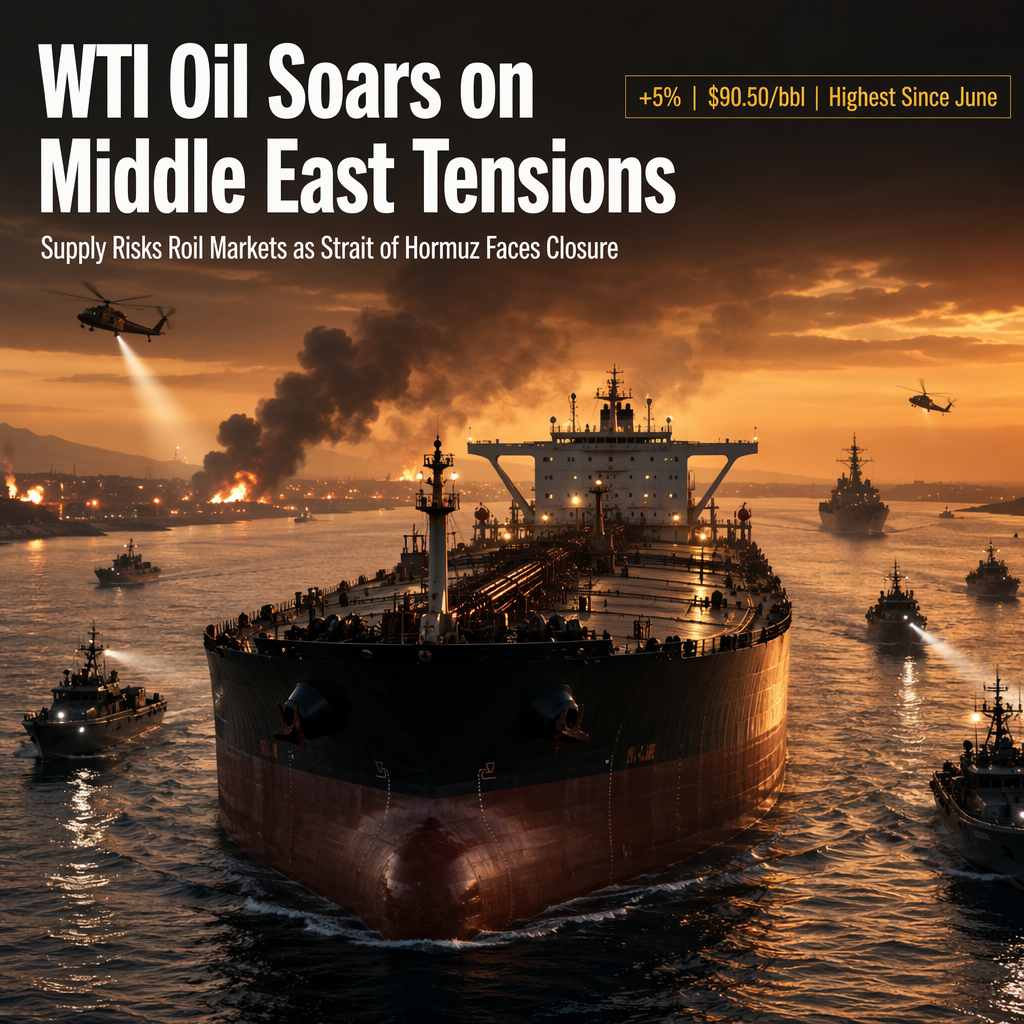
West Texas Intermediate (WTI) crude oil surged more than 5% on Thursday, trading around $90.50 per barrel, marking its highest level since June 11. This rally has contributed to a roughly 30% gain for WTI so far this month, driven by escalating tensions in the Middle East, particularly between the US and Iran [1]. The latest price spike was fueled by reports that Yemen’s Houthis attacked two Saudi oil tankers near the Bab el-Mandeb Strait, intensifying concerns over supply disruptions and adding a fresh geopolitical risk premium to oil prices [1].
Iran’s Revolutionary Guards declared the Strait of Hormuz “completely closed” while US military operations continue, warning that vessels would not be allowed to pass without coordinating with Iranian authorities. This assertion underscores the strategic importance of the region for global energy flows and heightens the risk of broader supply interruptions [1].
Analysts at MUFG highlighted that the key market risk is whether the conflict escalates further, potentially triggering a broader global energy shock. The bank also noted that President Donald Trump has threatened to target Iranian bridges and power infrastructure if Tehran attacks vessels transiting the Strait of Hormuz, while Iran has warned it would retaliate against energy infrastructure across the Gulf region [1].
From a technical perspective, WTI maintains a bullish bias, trading above its 21-day, 50-day, and 100-day Simple Moving Averages (SMAs), which are clustered between approximately $75.50 and $88.20. The MACD indicator is firmly above zero, and the Relative Strength Index (RSI) at 71 indicates overbought conditions, suggesting strong upside momentum but also the possibility that the rally could be stretched in the short term. Resistance is seen near $95.00 and $105.00, while support levels are identified at $88.20, $82.40, $80.00, and further down at $75.52 and $67.00 [1].
CONCLUSION
WTI crude oil's sharp rally reflects heightened geopolitical risks in the Middle East, with market participants closely monitoring potential supply disruptions. Technical indicators point to strong momentum, but also caution that the rally may be overextended in the short term. The situation remains fluid, with further escalation posing risks of a broader global energy shock.